Before you pay: arrange a battery health check, confirm the recall status and remaining warranty, and compare the total ownership costs. The sections below explain what to check and where to find the supporting sources.
On this page
Used electric cars are finally cheap enough to be interesting. Pickles reports that used EVs are “generally selling for around 60 to 70 per cent of their original new-car price”. Separately, figures from the Australian Automotive Dealer Association and AutoGrab have used EV sales up 54.6 per cent in the first half of 2026 while the broader second-hand market went backwards.
The catch is that buying a used electric car asks you to check one thing a petrol buyer never has to think about, and to give up several protections you would assume are automatic. Neither of those is obvious from a listing.
The used electric car Australia market has moved fast in the last year. Here is what actually matters, and what it costs to find out.
The prices are moving, and the headline number is misleading
Pickles’ auction figures for 2026, reported by the NRMA, show the average used EV selling for $35,500 in January, peaking at $41,500 in April, then $35,500 in May and $31,500 by June.
Read that as a $4,000 collapse in six months and you have been caught by a mix effect. Over the same period the average odometer reading of the EVs Pickles sold went from about 29,000 kilometres to about 51,000. They were selling different cars, not the same cars for less. An extra 22,000 kilometres on the clock is worth more than $4,000 on its own.
The model-level figures in Pickles’ quarterly report tell a cleaner story: “Three-year-old Tesla Model 3 vehicles, which had previously been transacting in the low-$30,000 range, are now closer to $40,000, while some BYD Atto 3 models that had been available in the mid to high $20,000s are now closer to $30,000.”
Prices at the top of the used EV market went up in the first half of 2026, not down. If you were waiting for the bottom, it may already have gone past.
The one check a petrol buyer never has to make
A used petrol car’s engine either runs or it does not. A used EV’s battery is somewhere on a curve, and nothing on the dashboard tells you where.
State of health is the number you want, and there are now several Australian services that will measure it. The NRMA charges “$250 for My NRMA Rewards members (RRP $300)” and gives you “a battery health score out of 100, your EV’s current battery capacity, and any potential issues that might affect performance or lifespan”. Note the coverage limit before you plan around it: the service is “currently available in Sydney Metro areas and Canberra, on weekdays from 8am-4pm”. TestMyEV runs a nationwide mobile version from about $248, and some Sydney pre-purchase inspectors add a battery test to an ordinary inspection for less.
Now the part nobody mentions. There is no Australian standard for this test, and no NATA accreditation behind it. What you are buying is a commercial protocol. The Australian Electric Vehicle Association’s batteries policy, published in February 2026, says the market “is developing quickly in Australia” and argues for tests “which conform to international standards” plus an Australian battery passport regime harmonised with the European Union. In other words, the association that would most like this to exist is still asking for it.
So a health check is worth paying for, and it is a snapshot from one provider rather than a certified number. Two hundred and fifty dollars against a $35,000 purchase is cheap either way.
What degradation actually does to a three-year-old car
Geotab’s 2026 fleet analysis, covering more than 22,700 electric vehicles, puts average degradation at 2.3 per cent a year.
One caveat before anyone does arithmetic with that. Geotab says the loss is not evenly spread: many electric cars “show a sharper drop in capacity in the first year or two before the rate levels out”. Treating 2.3 per cent as a flat annual rate is a rough approximation, and on a young car it will flatter the result.
With that caveat, put it together with the only independent Australian range measurements and you get something more useful than either number alone. The Australian Automobile Association measured a BYD Dolphin Essential at 313 kilometres when new. Run it forward three years at a flat 2.3 per cent and you get about 291 kilometres. Its measured 2025 Tesla Model Y RWD did 450 kilometres, and the same sum gives about 419.
That Model Y will not actually be three years old until 2028, so treat it as a worked example rather than a car you can go and look at this weekend. The method is what transfers, not the number.
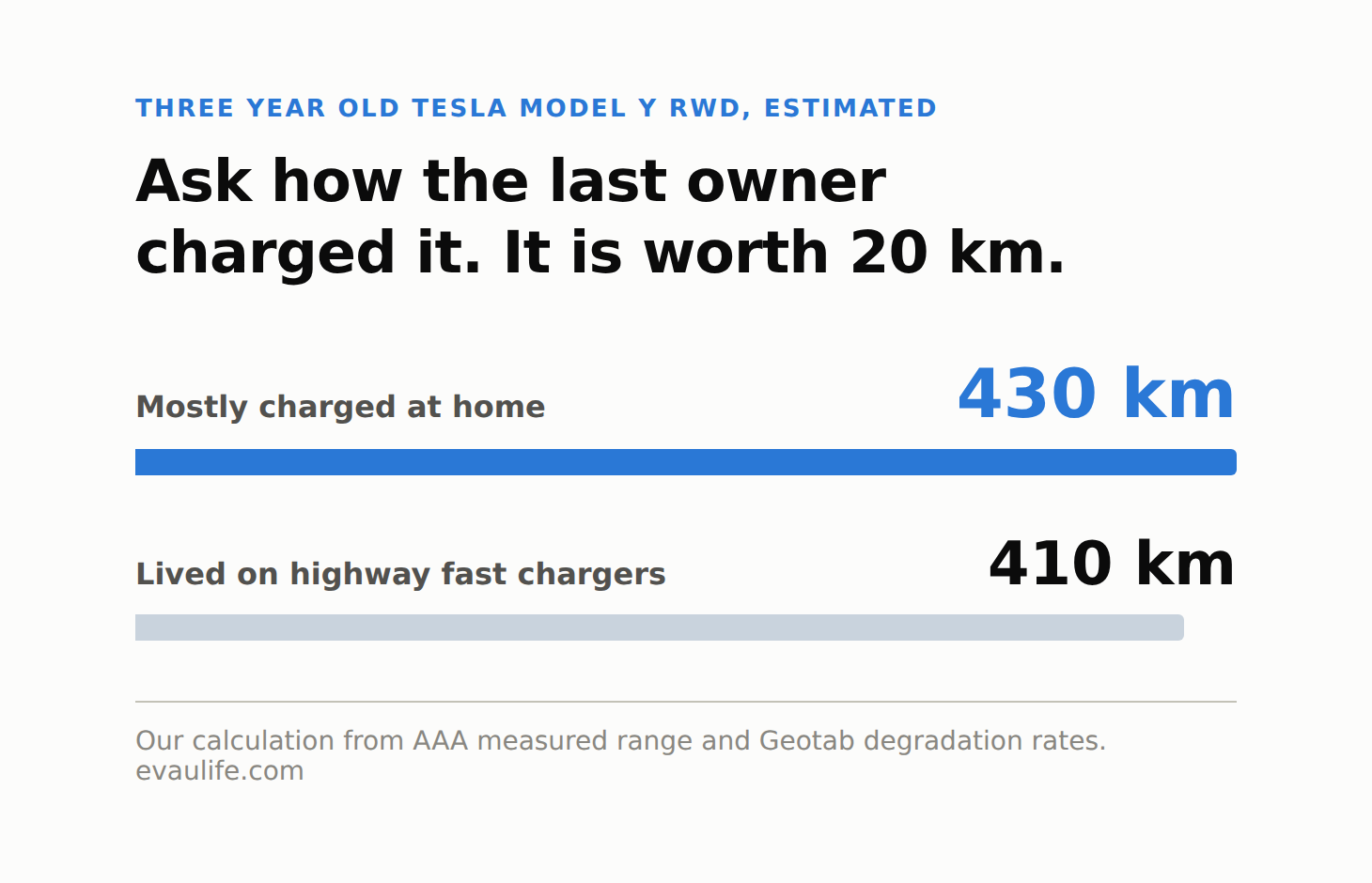
Charging history matters too, though less than the age of the car. Geotab found cars where DC fast charging made up under 12 per cent of sessions averaged 1.5 per cent degradation a year, while cars regularly fast charging above 100 kW averaged 3.0 per cent. Apply both to that Model Y at three years old and you get 430 kilometres for the home-charged one and 410 for the one that lived on highway chargers. Twenty kilometres of range, decided by how the last owner used it. Worth having in proportion: three years of age costs that Model Y 31 kilometres on these figures, and the difference between the gentlest and harshest charging habit costs 20.

Which is why “how did you charge it” is still worth asking, even though it is the smaller of the two effects. The age of the car you can read off the compliance plate. How the last owner treated it is the part no listing tells you, and it is why a car with a service history at a suburban address is worth more than one that came off a fleet doing intercity runs. There is more on how those degradation figures were measured in our piece on how long EV batteries last.
What the battery warranty is worth to a second owner
This is the good news, and it is better than most buyers expect.
Most electric cars sold here carry an eight year battery warranty, and every one of them is also capped in kilometres. BYD, Hyundai and Tesla all cap the standard car at 160,000 km, and Tesla stretches it to 192,000 km on Long Range and Performance versions of the Model 3 and Model Y. Eight years or that distance, whichever lands first.
The brands do say plainly that the cover follows the car. BYD’s warranty handbook states the new car warranty “runs with the vehicle and is transferable from owner-to-owner conditional upon the standard warranty terms”. Hyundai puts it more cheerfully: “the balance of your warranty transfers to the new owner”. Read that one carefully, because it sits in the section about the general vehicle warranty and Hyundai publishes no equivalent sentence for the high-voltage battery specifically. Tesla says “Your New Vehicle Limited Warranty will follow your vehicle and be transferred to the new owner when a vehicle ownership transfer is performed through Tesla”, which again names the vehicle warranty rather than the battery one.
Tesla’s condition is the one to act on. A private sale that never goes through Tesla’s own ownership transfer process is a private sale where the warranty may not follow you. Ask the seller to do it while you are standing there.
Three things to check on any car you are looking at. First, how much of the eight years is left, because a 2021 car has used more than half of it. Second, how many kilometres are on it, because the distance cap can expire long before the years do, and Hyundai’s general warranty runs to unlimited kilometres while its battery warranty stops at 160,000. Third, what the warranty actually promises. These are capacity warranties with a floor, and BYD, Hyundai and Tesla all set it at 70 per cent, so a battery that has lost 20 per cent of its capacity is degraded and not defective. The warranty is protection against failure, not against the ordinary decline you are buying into.
Buying privately strips almost all your protection
This is the part that surprises people, and it applies equally to petrol cars. It just matters more when the expensive component is one you cannot see.
The ACCC is blunt: “Most consumer guarantees and state and territory laws don’t apply to second-hand cars bought through private or auction sales.”
In New South Wales the difference is stark. Buy from a licensed dealer and you get a statutory dealer guarantee: three months or 5,000 kilometres, whichever comes first, on any used vehicle less than 10 years old that has travelled under 160,000 kilometres. Buy from the bloke down the road and NSW’s own guidance says: “If you buy a vehicle from a private seller, you are not covered by the MDRA or Australian Consumer Law.”
There is a second NSW trap worth knowing about, and it is one the insurance industry has complained about. Written-off light vehicles “cannot be re-registered in NSW, except in limited circumstances”, and a vehicle on that register “can still be bought and sold, but only used for parts or scrap metal”. The Insurance Council of Australia notes that damaged EV battery packs get written off conservatively, because without diagnostic data an insurer cannot certify the cells are safe. That combination means a cheap used EV with an interesting history can be a car you legally cannot register.
One more NSW detail matters if you are buying at auction, which is where a lot of the cheap stock is. The dealer guarantee can be switched off there, but only on a condition: it does not apply where “a vehicle is bought at auction with a dealer’s notice specifying that dealer guarantees do not apply”. So an auction purchase does not automatically strip your cover. Look for that notice, and ask for it in writing if nobody hands it to you.
A Personal Property Securities Register check costs a couple of dollars and tells you whether there is money owing and whether the car is recorded as stolen or written off. Do it before you inspect, not after.
Check the recall register first
This takes two minutes and almost nobody does it.
Hyundai’s Kona EV has three battery recalls on the Australian register, not the one most people remember.
REC-000604 was published on 18 November 2020 and covered 796 vehicles built between 2018 and 2020, for a defect where “the Lithium-ion battery may have internal damage or the battery management system (BMS) control software may cause an electrical short circuit after charging”.
REC-001592 followed on 23 August 2021, covering another 615 cars from the same 2018 to 2020 build window, this time because “due to a manufacturing defect, the battery does not meet specifications and may lead to an electrical short which could start a fire”.
The third is current and much bigger. REC-006586 was published on 9 April 2026 and covers 3,479 Kona EVs built between 2018 and 2023, for a defect where “a software issue in the Battery Management System (BMS) may cause an electrical short circuit while charging or parked leading to a vehicle fire”. A companion recall the same day, REC-006587, covers 1,403 Ioniq Electrics for the same fault.
That third recall is four months old. Any used Kona EV of that age advertised today may or may not have had the fix applied, and the only way to know is to check the VIN against the register and ask for the paperwork. The same applies to every other brand. The register is free and searchable.
The things that do not come with the car
Software and subscriptions are the modern version of finding no spare key in the glovebox.
Tesla is the clearest example. Full Self-Driving and Enhanced Autopilot stay with the vehicle: “Once you transfer your EAP or FSD (Supervised), it will stay with the new vehicle. If you sell the new vehicle, EAP or FSD (Supervised) will stay with the vehicle and be available to the new vehicle owner.” Premium Connectivity does not. Tesla’s own wording is that “your Premium Connectivity subscription cannot be transferred to another vehicle”, and that on an ownership transfer “any associated Premium Connectivity subscription will be automatically cancelled”.
Then there are the physical bits. Check the car comes with its charging cables, because a Tesla Mobile Connector is a $550 accessory to replace and the Type 2 cable that lets you use a public AC charger is another few hundred. A seller who has lost both has knocked close to a thousand dollars off what the car is worth to you.
Zeekr, XPeng, Deepal and several other brands have barely been here long enough to produce a used market at all, so if that is where you are looking, you are effectively shopping new. Worth checking with a Zeekr dealership in Sydney, or whoever holds the franchise, before you assume a used one exists.
What a used electric car Australia buyer should budget
Budget about $400 and an afternoon.
A battery state of health test is $250 at the NRMA if you are in Sydney or Canberra, or about $248 for a mobile test elsewhere. A PPSR check is a few dollars. A recall register search is free. A standard pre-purchase inspection covers everything an EV shares with a petrol car, which is most of it: suspension, steering, tyres, brakes, panel alignment and crash history.
Then price the two running costs that do not behave the way people expect. Insurance barely falls with age on either fuel, so do not budget for a discount just because the car is a few years old. CHOICE’s quote data has the average electric premium at $2,440 for a new car and $2,441 for a four year old one, and the petrol column is just as flat, moving from $1,865 to $1,920 across the same span. The electric figure simply sits higher throughout. And the real range is not the brochure figure, on any car at any age. We went through both in detail in what 16,000 insurance quotes actually show and in running costs in Sydney.
If you are buying from a dealer rather than privately, ask for the recall status against the VIN and the remaining battery warranty in writing before you talk about price. Zeekr Chatswood or any franchised dealer should produce both in a few minutes, and a seller who will not is telling you something.
Buying a used electric car is a good idea at these prices. It needs an extra afternoon of homework compared with a petrol car, and about $400, and both are cheap against what they protect.
Common questions
How do I check a used EV’s battery health in Australia?
Pay for a state of health test. The NRMA charges $250 for members and $300 otherwise, and gives a score out of 100 plus a current capacity figure, though the service only runs in Sydney Metro and Canberra on weekdays. TestMyEV offers a nationwide mobile test from about $248. Be aware there is no Australian standard or accreditation behind any of these tests.
Does the battery warranty transfer to me?
Usually yes. BYD says its warranty “runs with the vehicle and is transferable from owner-to-owner”, and Hyundai says “the balance of your warranty transfers to the new owner”, though that sentence is about the general vehicle warranty rather than the battery specifically. Tesla’s transfers only when the ownership change is processed through Tesla, and its wording also names the vehicle warranty rather than the battery one. Check how many of the eight years are left and how many of the kilometres, because BYD, Hyundai and Tesla all cap the battery at 160,000 km on a standard car. All three set the capacity floor at 70 per cent, so ordinary degradation is not a defect.
How much range will a three-year-old EV have lost?
On Geotab’s fleet average of 2.3 per cent a year, roughly 7 per cent, though Geotab notes the loss is front-loaded rather than even, so a flat rate flatters a young car. Charging history moves it further: cars that rarely fast charge averaged 1.5 per cent a year and cars regularly fast charging above 100 kW averaged 3.0 per cent. Age still moves it more than charging habit does.
Is it safer to buy from a dealer than privately?
Legally, yes, and by a wide margin. In New South Wales a licensed dealer owes you a statutory guarantee of three months or 5,000 kilometres on a used vehicle under 10 years old and under 160,000 kilometres. NSW’s own guidance states that in a private sale “you are not covered by the MDRA or Australian Consumer Law”.
What is a used EV worth compared with new?
Pickles reports used EVs “generally selling for around 60 to 70 per cent of their original new-car price”, and notes three-year-old Tesla Model 3s moving from the low $30,000s to closer to $40,000 during the first half of 2026.
Prices, warranty terms, recall records and guidance in this article are taken from the named organisations’ own Australian publications as at the time of writing. Degradation figures are Geotab’s fleet averages and range figures are from the Australian Automobile Association’s Real-World Testing Program. Projections combining the two are our own calculation and are an estimate, not a measurement of any individual car.
Leave a Reply