Insurance is the line people leave out of the sums, and it is not a small one. On CHOICE’s January 2026 quote data a new electric car costs $575 a year more to insure than a new petrol car, and four years later the gap is still there. Across the first four years it runs between $484 and $583 a year, with no sign of closing.
CHOICE collected more than 16,000 comprehensive quotes for electric vehicles in January 2026, alongside nearly 18,000 for hybrids and over 36,000 for petrol cars, and published the results broken down by brand and by vehicle age. Very little Australian data of this kind gets published, and the age breakdown is the part almost nobody uses.
Here is what electric car insurance Australia actually costs once you read past the average.
On this page
The gap is real, and it does not close
Here is CHOICE’s published average annual premium by vehicle age.
| Vehicle age | Electric | Petrol | Difference |
|---|---|---|---|
| New | $2,440 | $1,865 | $575 |
| 1 year old | $2,458 | $1,949 | $509 |
| 2 years old | $2,490 | $1,907 | $583 |
| 3 years old | $2,430 | $1,946 | $484 |
| 4 years old | $2,441 | $1,920 | $521 |

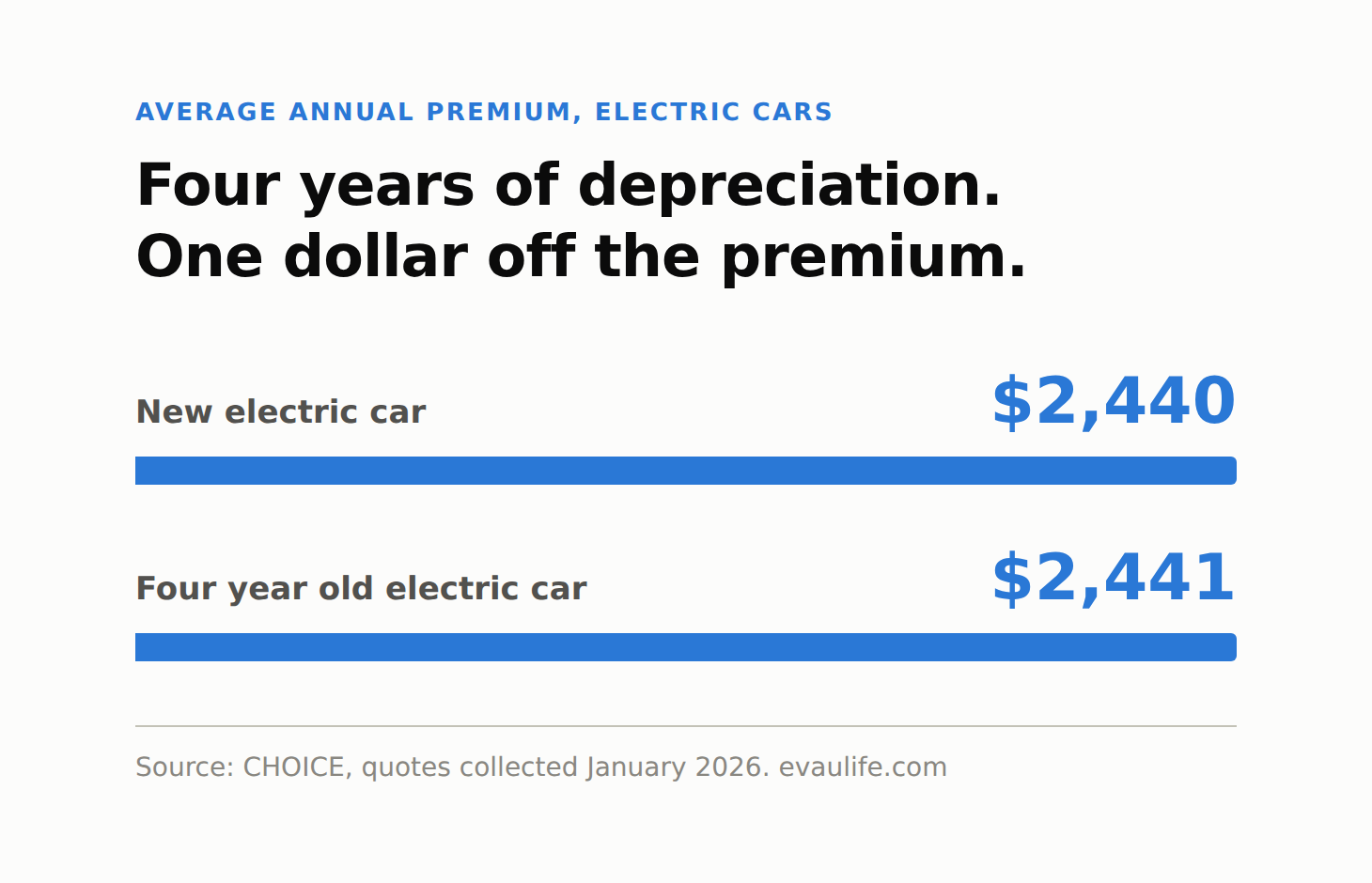
Look at the electric column on its own. New $2,440. Four years old $2,441. One dollar apart.
Repair and replacement cost is a big input into a comprehensive premium, and a four-year-old car is worth substantially less than a new one, so you would expect some fall. Premiums also price how likely a claim is at all, which is why depreciation on its own does not decide the number. The petrol column does not fall either. But it starts $575 lower and stays lower. Add the five bands up and the electric side comes to $12,259 against $9,587 for petrol, a difference of $2,672 over five years.
CHOICE states that “owners of 1- to 4-year-old electric vehicles overall pay 22–27% more for insurance than owners of petrol cars of the same age”. Divide the published averages age by age and you get a slightly higher range, 25 to 31 per cent. That is what you would expect, because comparing matched quotes and dividing one published average by another are two different sums. The same pattern shows up on the new-car figure, where CHOICE reports that “owners of new electric vehicles pay nearly 30%, or $575, more for a year of insurance than owners of new petrol cars” while its own averages divide out at 31 per cent. The method is consistent. The dollar figures are the ones to work with.
One figure to be careful with. CHOICE also publishes a headline comparison that is not age-matched: “The average premium for an electric vehicle is $2545, whereas the average premium for a petrol vehicle is $1702. Electric vehicle owners pay around 40% or $843 per year more than petrol car owners.” That $843 is the number that gets quoted everywhere, and it sets the whole EV fleet against the whole petrol fleet rather than car against car of the same age.
You can see the effect in CHOICE’s own numbers. The all-ages petrol average of $1,702 sits below every petrol figure in the table above, which run from $1,865 to $1,949, so older and cheaper petrol cars are dragging that side down. The electric average of $2,545 does the opposite, sitting above every electric figure in the table, which top out at $2,490. Both ends of the comparison are being pulled apart by cars the age table does not cover. If you are buying new and comparing against a new petrol car, $575 is the age-matched number.
What electric car insurance Australia costs by brand
This is the table worth spending time on. Every figure is CHOICE’s published average annual premium. A blank means CHOICE could not price that cell, and it explains why: “If a brand isn’t present for a certain vehicle age, this is because there weren’t enough quotes available.”
| Brand | New | 1 year | 2 years | 3 years | 4 years |
|---|---|---|---|---|---|
| Geely | $1,622 | $2,219 | |||
| Kia | $1,774 | $2,150 | $1,593 | $1,891 | $3,424 |
| BYD | $2,220 | $2,056 | $1,971 | $1,859 | $1,754 |
| BMW | $2,706 | $3,174 | $3,463 | $3,443 | |
| Tesla | $2,985 | $2,730 | $2,679 | $2,684 | $2,633 |
| Mini | $1,457 | ||||
| Nissan | $1,705 | $1,612 | $2,029 | ||
| Hyundai | $1,801 | $2,864 | |||
| Volvo | $2,104 | $2,205 | $2,143 | $1,746 | |
| Polestar | $2,309 | $2,190 | |||
| Cupra | $2,930 | $2,176 | |||
| Mercedes-Benz | $2,970 | $3,243 | $3,570 | $3,189 | |
| MG | $1,760 | $1,758 | $1,378 |
The spread is enormous. The cheapest single figure in that table is $1,378 for a four-year-old MG. The dearest is $3,570 for a three-year-old Mercedes-Benz. That is 2.6 times the premium, on the same standardised excess, in the same month. Most of that is the cars themselves. CHOICE says brand matters “due to things like the price tier of the brand, the availability and price of spare parts and service centres, and even the rate of theft and presence of safety features”.
On new cars only, CHOICE puts it plainly: “Geely are the cheapest EVs to insure, with an average cost of $1622 for a new car, and Tesla the most expensive, at an average cost of $2985.” That is $1,363 a year between the cheapest and dearest new EV brand, which over five years is $6,815. Both are brand averages across whatever models CHOICE could price, so it is not a model against model comparison. It is still real money, and it is the number people leave out when they compare two cars on purchase price alone.
Two brands get more expensive as they get older
Read the rows left to right and something odd shows up.
BYD falls steadily: $2,220 new, then $2,056, $1,971, $1,859 and $1,754 by four years old. That is a $466 drop, and it is what you would expect as a car depreciates. Tesla falls too, from $2,985 to $2,633.
BMW goes the other way: $2,706 new, then $3,174, then $3,463, and $3,443 at four years old. That is $737 more expensive to insure at four years old than it was new. Mercedes-Benz does the same thing across the ages it appears at, from $2,970 at one year to $3,189 at four.
If a BMW or a Mercedes-Benz is on your list, price that pattern before you sign, because it compounds every year you keep the car. It is not a European thing in general. Volvo, Polestar and Cupra all end lower than they start.
Geely, Hyundai and Kia also finish higher than they start. Geely and Hyundai have only two cells each, and Kia’s row swings $1,831 between its lowest and highest. BMW and Mercedes-Benz are the only two that climb across a run of ages.
One caution on reading single cells. CHOICE notes the brand-by-age figures rest on “a market-representative sample of between 50 and 2700 quotes per brand per year of vehicle age”. A cell built on 50 quotes moves a long way on very little. Kia’s run is the obvious example: $1,774 new, $2,150, $1,593, $1,891, then $3,424 at four years old. Nothing plausible happens to a Kia in its fourth year to nearly double its premium. Treat that $3,424 as a thin sample. Read the trend across a row before you trust any one cell.
Why EVs cost more, in the insurers’ own words
CHOICE blames the repair chain: “The parts network in Australia isn’t as well established for EVs as it is for combustion engines, so you’re more likely to have parts imported from overseas to repair your car. On top of that, there’s not as many trained EV technicians in Australia yet, so the labour for repairs is higher.”
The mechanical argument runs the other way, which is why this catches people out. As CHOICE notes, “EVs are estimated to have 20 moving parts compared to over 2000 for a combustion vehicle, so they are less likely to require repairs.” Fewer things break. The things that do break cost more to fix and take longer to source.
The Insurance Council of Australia’s Charging Ahead paper from May 2024 (full PDF) puts numbers on the repair side, though with an important caveat: its headline repair statistic comes from the United Kingdom. The paper reports that “a recent survey indicated that EVs cost up to 25 per cent more and take 14 per cent longer to repair than ICE vehicles”, and footnotes it to Thatcham Research in the United Kingdom. No equivalent Australian study is cited.
Two ICA points are specific to here and matter more. The first is about batteries: “insurers have seen scratched battery packs where the cells inside are likely undamaged, however without diagnostic data the vehicle had to be written off.” A cosmetically damaged pack that cannot be certified as safe is a total loss, and the ICA says batteries are “one of the most expensive parts of an EV, with replacement often costing between US$5000 to US$20,000 (AU$7,500 to AU$30,000), up to 40 percent of the EV’s total value”. That range is the ICA’s own figure, given in US dollars and converted. It is not an Australian price list. No manufacturer or dealer here publishes one, which is the same wall we hit writing about how long EV batteries last.
The second is a New South Wales problem specifically. The ICA notes that “currently, written-off vehicle laws are applied inconsistently across states with New South Wales having an especially restrictive set of rules”. If you are insuring an EV in Sydney, that is worth knowing, because it changes what happens after a claim, not what you pay before one.
CHOICE also records that “as the networks develop in Australia, repair costs should come down”. That is the optimistic reading, and it is plausible. It is not something to budget on today.
The brands that are not in the data
Notice who is missing. There is no Zeekr row, no XPeng, no Leapmotor, no Chery, no GWM, no Deepal. That is a sample size problem rather than a verdict on the cars. CHOICE’s note reads “if a brand isn’t present for a certain vehicle age, this is because there weren’t enough quotes available”, and none of these six cleared that bar at any age.
That has a practical consequence. If you are buying from a newer brand, there is no published benchmark to check a quote against, and you are relying entirely on shopping around. It is worth getting three or four quotes before you commit to the car, because the insurance figure can move the five year cost more than the options list does. If a 7X or an X is on your list, a Zeekr dealership in Sydney is where that conversation starts.
What is actually covered
A few things here are worth knowing and are not obvious.
Australian insurers do not generally sell EV-specific policies. CHOICE is direct about it: “Australian insurers don’t generally sell separate EV policies.” Your EV goes on an ordinary comprehensive policy.
Charging equipment usually sits inside the car’s insured value. CHOICE records that “Kogan and Allianz specify that wall chargers and charging cables are included in the value of, and insured with, your car”. Check yours, because a wall charger and installation is a four figure item and you do not want to discover it sits in a gap between two policies. We went through what that hardware costs in a separate guide to home charging.
Battery fire is covered as fire. CHOICE notes that “Allianz also points out that battery thermal runaway (when the internal temperature of a battery rapidly increases in a self-sustaining way, potentially leading to fire or explosion) is covered under fire incidents.”
How to use these numbers
Get a quote before you buy. On CHOICE’s new-car figures the gap between the cheapest and dearest brand is $1,363 a year, which is larger than the difference in running costs between most of the cars on your list. Any dealer worth dealing with, Zeekr Chatswood included, will wait a day while you check.
Compare like with like on age. If you are buying new, the number to beat is $2,440. If you are buying a three-year-old car expecting the premium to have fallen, look at the age table again, because on average it has not.
Read the whole row. Some of these cells rest on 50 quotes.
And put the figure into your total from the start. Insurance is one of the three or four numbers that actually decide which electric car is cheapest to own, and we stacked all of them up for mid-size electric SUVs and for electric SUVs generally.
Common questions
How much does it cost to insure an electric car in Australia?
CHOICE’s January 2026 quote collection puts the average for a new electric car at $2,440 a year against $1,865 for a new petrol car. By brand, new-car averages range from $1,622 for a Geely to $2,985 for a Tesla.
Why is EV insurance more expensive?
CHOICE attributes it to the repair chain: parts are more likely to be imported and there are fewer trained EV technicians here, so labour costs more. The Insurance Council of Australia adds that a damaged battery pack that cannot be certified as safe can force a write-off even when the cells are probably fine.
Does EV insurance get cheaper as the car ages?
On this data, barely. The average for a new EV is $2,440 and for a four-year-old EV it is $2,441. Individual brands differ: BYD falls $466 across those four years while BMW rises $737.
Are wall chargers and cables covered?
Often, under the car policy. Check whether yours does. CHOICE records that Kogan and Allianz include wall chargers and charging cables in the value insured with the car. Confirm it with your own insurer in writing.
Is there a special EV insurance policy in Australia?
Generally no. CHOICE states that “Australian insurers don’t generally sell separate EV policies”, so an electric car goes on standard comprehensive cover.
Premium figures in this article are CHOICE’s published averages from a market-representative sample of quotes collected in January 2026 and last updated on 25 March 2026, adjusted to a standardised excess. They are averages across many customer profiles and are not a quote. Your own premium depends on your age, address, driving record and excess.
Leave a Reply