Yes, they do. Far less than a petrol car, and the bill varies more between two electric cars from the same brand than most buyers would ever guess.
The line you hear is that electric cars barely need servicing because they have a fraction of the moving parts. That is true about the mechanics and close to useless about the money. One brand selling here publishes a full price list for its electric range, and inside that single list the cheapest car costs $1,308 for five services while the dearest costs $2,389.
So the honest answer to do electric cars need servicing is yes, and the more useful question is what your specific variant costs, because two of the biggest EV brands in this country will not tell you before you buy.
On this page
- What is actually on an EV service sheet
- Kia publishes prices for its whole electric range, and they are not what you would guess
- How that compares with a petrol or hybrid equivalent
- Two of the biggest EV brands here will not tell you the price
- So do electric cars need servicing, and is it cheaper?
- What to ask before you sign
- Common questions
What is actually on an EV service sheet
There is no combustion engine, so a long list of jobs disappears. RACV puts the difference plainly. “An internal combustion needs to have oil, an oil filter, a fuel filter and an air filter.” And: “You have components that add up over time to a fairly major cost on a car.”
What remains is inspection. RACV describes the EV equivalent as “an inspection of all the EV’s components, plus a diagnostic system check”.
Tesla is the clearest example of what that looks like when a manufacturer strips it right back. Tesla Australia publishes no scheduled service at all. Instead its vehicle maintenance page lists individual items with individual intervals:
| Item | Tesla’s recommended interval |
|---|---|
| Cabin air filter, Model 3 and Model Y | Every 2 years |
| Cabin air filter, Model S and Model X | Every 3 years |
| HEPA and carbon filter | Every 3 years |
| Tyre rotation | Every 10,000 km, or when tread depth differs by 1.5 mm between tyres |
| Brake fluid contamination test | Every 4 years |
| Brake caliper clean and lubricate | Every year or 20,000 km, in areas with road salt |
| Air conditioning desiccant bag | “Scheduled replacement is not required” across the current range. Older cars carry intervals: Model S built 2012 to 2020 every 2 years, Model 3 without a heat pump built 2017 to 2023 every 6 years, Model X built 2015 to 2020 every 4 years |
Tesla’s own framing of the difference: “Unlike petrol cars, Tesla vehicles require no traditional oil changes, fuel filters, spark plug replacements or emission checks.”
Read that table and you can see why the maintenance-is-nearly-free story took hold. A cabin filter every two years and a brake fluid test every four is not a service schedule in the sense a petrol owner would recognise. There is a catch. Tesla adds that “maintenance is required for eligibility in selected programs, such as Resale Value Guarantee”.
Most brands are not Tesla. They still want the car in a workshop every 12 months, and they still send you a bill.
Kia publishes prices for its whole electric range, and they are not what you would guess
Kia publishes the clearest EV price list in the market: one page, every variant, no calculator. MG and Hyundai publish prices too, but you have to dig them out of a pricing guide or a per-vehicle quote tool. These are Kia’s own prepaid EV service plan figures, sold as three, five or seven years of servicing.
| Kia model | 3 services | 5 services | 7 services | Average per service on the 5 plan |
|---|---|---|---|---|
| EV4 | $688 | $1,308 | $1,929 | $262 |
| EV3 | $695 | $1,320 | $1,946 | $264 |
| EV9 | $723 | $1,379 | $2,038 | $276 |
| EV6 Air and GT-Line | $728 | $1,391 | $2,055 | $278 |
| EV6 GT | $842 | $1,570 | $2,319 | $314 |
| EV5 Air | $1,185 | $1,839 | $2,892 | $368 |
| EV5 Earth and GT-Line | $1,517 | $2,389 | $3,667 | $478 |

Look at the EV9 and the EV5 Earth. The EV9 is Kia’s seven-seat flagship, a very large electric SUV. The EV5 Earth is smaller and cheaper. Over five services the EV9 costs $1,379 and the EV5 Earth costs $2,389. The bigger, dearer car is $1,010 cheaper to service.
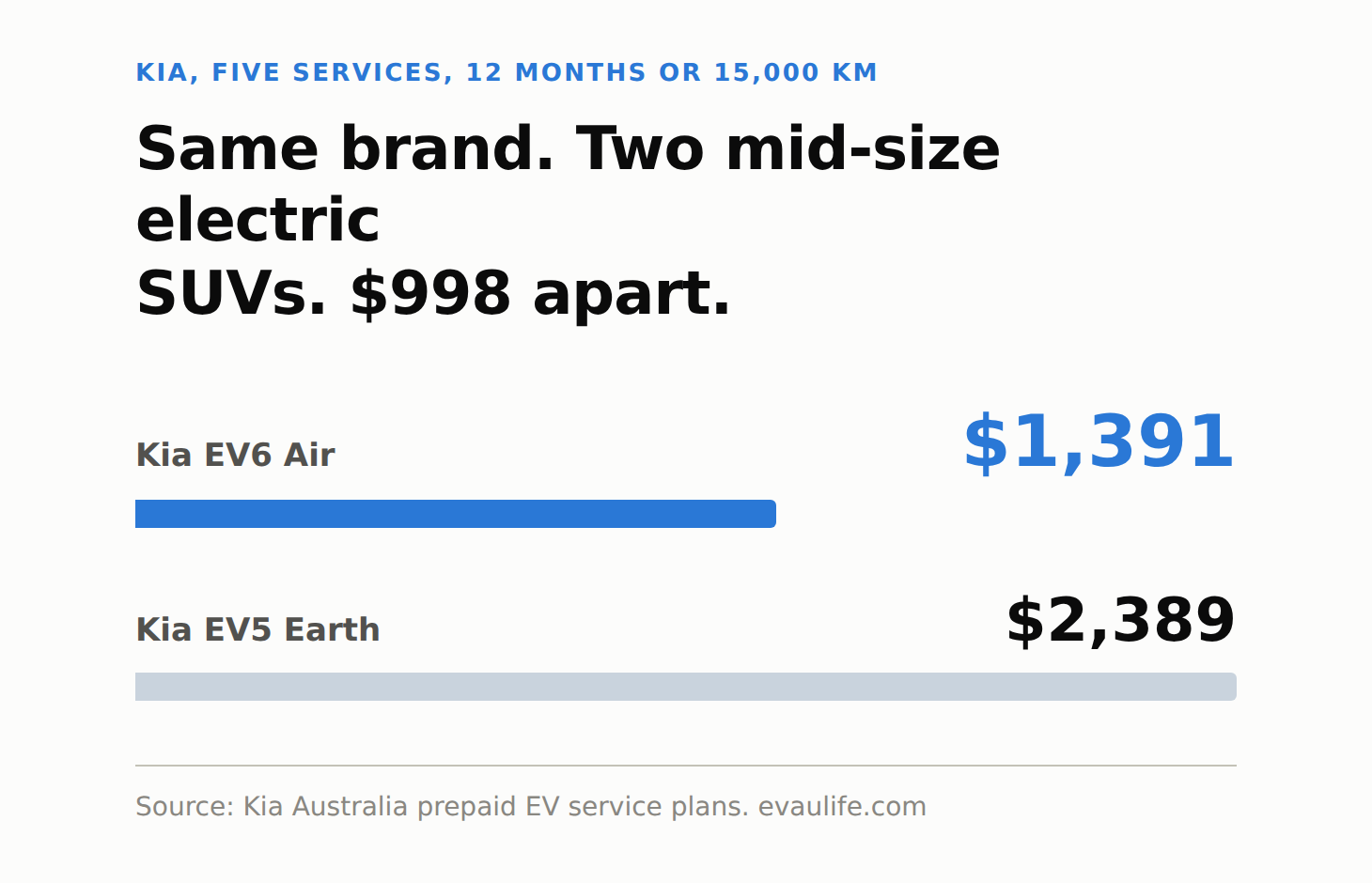
Now line up the two mid-size SUVs in the range. An EV6 Air is $1,391 over five services. An EV5 Earth is $2,389. That is $998 between two similar electric SUVs from the same manufacturer, serviced at the same dealerships. Over seven services the gap widens to $1,612.
Per visit, the EV5 Earth works out at $478 against the EV4’s $262. One Kia electric car costs 82 per cent more per service than another Kia electric car.
The assumption that electric equals cheap is why the servicing line usually gets skipped in a comparison. On Kia’s own numbers it is worth more than a thousand dollars over five years.
How that compares with a petrol or hybrid equivalent
Here is the comparison people actually want.
| Car | Five scheduled services |
|---|---|
| Toyota Corolla Hybrid | $1,250 |
| Kia EV4 | $1,308 |
| Kia EV3 | $1,320 |
| Kia EV9 | $1,379 |
| Kia EV6 Air | $1,391 |
| Kia EV6 GT | $1,570 |
| Toyota RAV4 Hybrid | $1,625 |
| Kia EV5 Air | $1,839 |
| Hyundai Tucson Hybrid | $1,871 |
| Mazda CX-5 2.5 petrol | $2,203 |
| Kia EV5 Earth | $2,389 |
A word on where those came from, because it matters. Kia’s figures sit on one public page. Toyota, Hyundai and Mazda publish nothing you can read without entering a registration number or a VIN, so their figures here are the ones quoted in dated coverage of the current models and in Mazda’s own calculator. Run your own lookup before you lean on them. Intervals also differ between brands, so the same annual distance does not always mean the same number of visits.
On these figures, five of Kia’s seven electric plans come in under a RAV4 hybrid and two do not, though the EV6 GT clears it by only $55. None of the seven undercuts a Corolla hybrid, the cheapest car in the table, and the closest Kia is $58 behind. Both margins are thin enough that one price rise on either side changes the answer.
The Mazda number is worth a second look because it shows what a petrol schedule actually does. Mazda alternates minor and major services rather than charging a flat fee: $352, then $526, then $352, then $621, then $352. That $621 in year four is the sort of visit an EV genuinely does avoid, and it is where the savings story comes from. It is also why an average is more honest than a headline price for a petrol car.
The Electric Vehicle Council states that “for some EV models, owners are estimated to save between $300-$400 every year in maintenance costs compared to an equivalent combustion engine vehicle”. Note the hedge at the front of that sentence, because it is doing a lot of work. The page carries no methodology, no study and no citation. Against Kia’s published prices, an EV5 Earth at $478 a visit costs more than a RAV4 hybrid at $325, not $300 to $400 less.
That does not make the EVC wrong about the fleet in general. Fuel is where the real saving sits, and we went through those numbers separately for Sydney running costs. It does mean the maintenance figure should not be dropped into a personal budget without checking your own model.
Two of the biggest EV brands here will not tell you the price
Tesla and BYD are two of the biggest electric car brands in the country. Neither publishes what servicing costs.
Tesla publishes intervals and no prices at all. Every item in the table above carries an interval and no dollar figure.
BYD publishes the opposite half. Its service and warranty page sets out the full schedule, every 12 months or 20,000 kilometres out to 72 months or 120,000 kilometres. Brake fluid, differential and electric drive fluid and the HEPA cabin filter are all replaced at 24, 48 and 72 months, and coolant at 48 and 72 months. The 48 month visit therefore carries four replacement items at once, which makes it the heaviest service in the schedule. BYD does not publish a price for any of them.
They are not alone. Zeekr’s Australian service page publishes neither a price nor an interval, and sends owners to a support line or an authorised partner: “For detailed support or information about your vehicle, please contact our Customer Support team or your local Zeekr Authorised Dealer Partner.” If a 7X is on your list, a Zeekr dealership in Sydney can put the schedule and the per-visit price in writing, which is what you want before you order rather than after.
That gap matters when you are comparing two cars. A Kia buyer can look up $1,391 over five years before they order. A BYD or Tesla buyer is asking a salesperson, and the answer is not a published figure anyone is held to.
So do electric cars need servicing, and is it cheaper?
They need servicing. It is usually cheaper than a petrol car, though not always, and rarely by as much as the marketing suggests.
The consumables list genuinely goes away. No engine oil, no oil filter, no fuel filter, no spark plugs, no emissions check. On a petrol car that is the expensive part of a major service, and it is why Mazda’s year four visit costs $621 while none of Kia’s electric plans has a single visit anywhere near that.
Everything else stays. Brake fluid still degrades and still gets replaced. Coolant still gets changed, because a battery pack and a drive unit both need thermal management. Cabin filters, tyres, suspension, steering and the 12 volt system all carry on as before. And the high voltage system adds diagnostic work that a petrol car does not have.
Brakes are the one place where the saving is real and hard to quantify. RACV puts it carefully: “EVs are said to save on brake pads since the regenerative braking process means traditional friction brakes aren’t relied on as much to stop.” We could not find a single Australian source that puts a credible number on how much longer EV pads last. The multipliers quoted on tyre and workshop websites disagree with each other by a factor of several, which tells you nobody has measured it properly here.
Tyres go the other way. RACV again: “Some EVs are known to wear out tyres quicker because they weigh more (thanks to those big battery packs)”. Tyres are not usually in a capped price plan, so that cost lands outside every table above.
What to ask before you sign
Ask for the schedule and the price in writing, per visit, for the exact variant rather than the model name. On Kia’s own list an EV5 Air is $1,839 over five services and an EV5 Earth is $2,389. Same model name, $550 apart.
Ask what the interval is, in months and kilometres, and get it from the owner’s manual rather than an advertisement. Kia does not run one interval across its electric range: its electric PV5 van is on 30,000 kilometres or two years while the passenger cars are annual. BYD runs 12 months or 20,000 kilometres, so over the same distance it sees a workshop fewer times than a brand on a shorter interval.
Ask what is excluded. Kia’s prepaid plans state they do not cover “additional maintenance or repair for wear and tear to items; fluid top ups or other items required between scheduled services”. Tyres, wipers and brake pads are wear items.
Ask whether the plan transfers and what happens if you sell. Kia’s does neither: “Prepaid service plans cannot be transferred to another vehicle.” And: “No refunds or credits for the remaining value of any services will be issued for unused prepaid services or if the vehicle is sold or rendered no longer drivable prior to expiry of its prepaid service plan.” Note you also have to decide early. Kia sells these “at the time of buying your new vehicle or during the first 11 months of ownership”.
Ask what happens to the warranty if you service elsewhere. BYD’s warranty handbook lists failure to service the car in accordance with the manufacturer’s specifications as an exclusion, and several brands tie their longest advertised warranty term to dealer servicing. Zeekr Chatswood and every other dealer should be able to answer that in one sentence.
And put the servicing figure into the same spreadsheet as everything else. It is smaller than depreciation and smaller than insurance, but it is a real four figure sum over five years, and it does not always move in the direction people assume. We put the whole cost stack side by side for mid-size electric SUVs if you want to see where it sits against the rest.
Common questions
How often does an electric car need servicing in Australia?
Usually every 12 months. Kia sells its electric plans in three, five and seven year lengths and does not publish a single kilometre interval across its electric range, so check the owner’s manual for your variant. BYD runs 12 months or 20,000 kilometres. Tesla is the outlier and publishes no scheduled service, only individual items such as a cabin filter every two years and a brake fluid test every four.
How much does it cost to service an electric car?
On Kia’s price list, which is the clearest one published in Australia, five years of servicing ranges from $1,308 for an EV4 to $2,389 for an EV5 Earth. That is $262 to $478 a visit depending on the model.
Do electric cars still need brake fluid and coolant changed?
Yes. BYD’s own schedule replaces brake fluid at 24, 48 and 72 months and coolant at 48 and 72 months. Tesla recommends testing brake fluid for contamination every four years.
Is servicing an EV cheaper than a petrol car?
Often, and not always. Five of Kia’s seven electric plans beat a RAV4 hybrid over five years and two do not, and none of them beats a Toyota Corolla hybrid at $1,250. The engine consumables bill is the part that reliably goes away.
Does skipping a service void an EV warranty?
It can affect a claim. BYD’s warranty handbook lists failure to service the car to the manufacturer’s specifications as an exclusion, and several brands tie their longest advertised warranty term to servicing inside the dealer network. Separately from any of that, your rights under the Australian Consumer Law are not cancelled by servicing elsewhere, provided the work was done properly and on schedule. Keep the invoices.
Servicing prices in this article are taken from each manufacturer’s own Australian pricing, or from a dated manufacturer announcement, as published at the time of writing. Capped price and prepaid plans change without notice. Confirm the current figure for your specific variant before you rely on it.
Leave a Reply