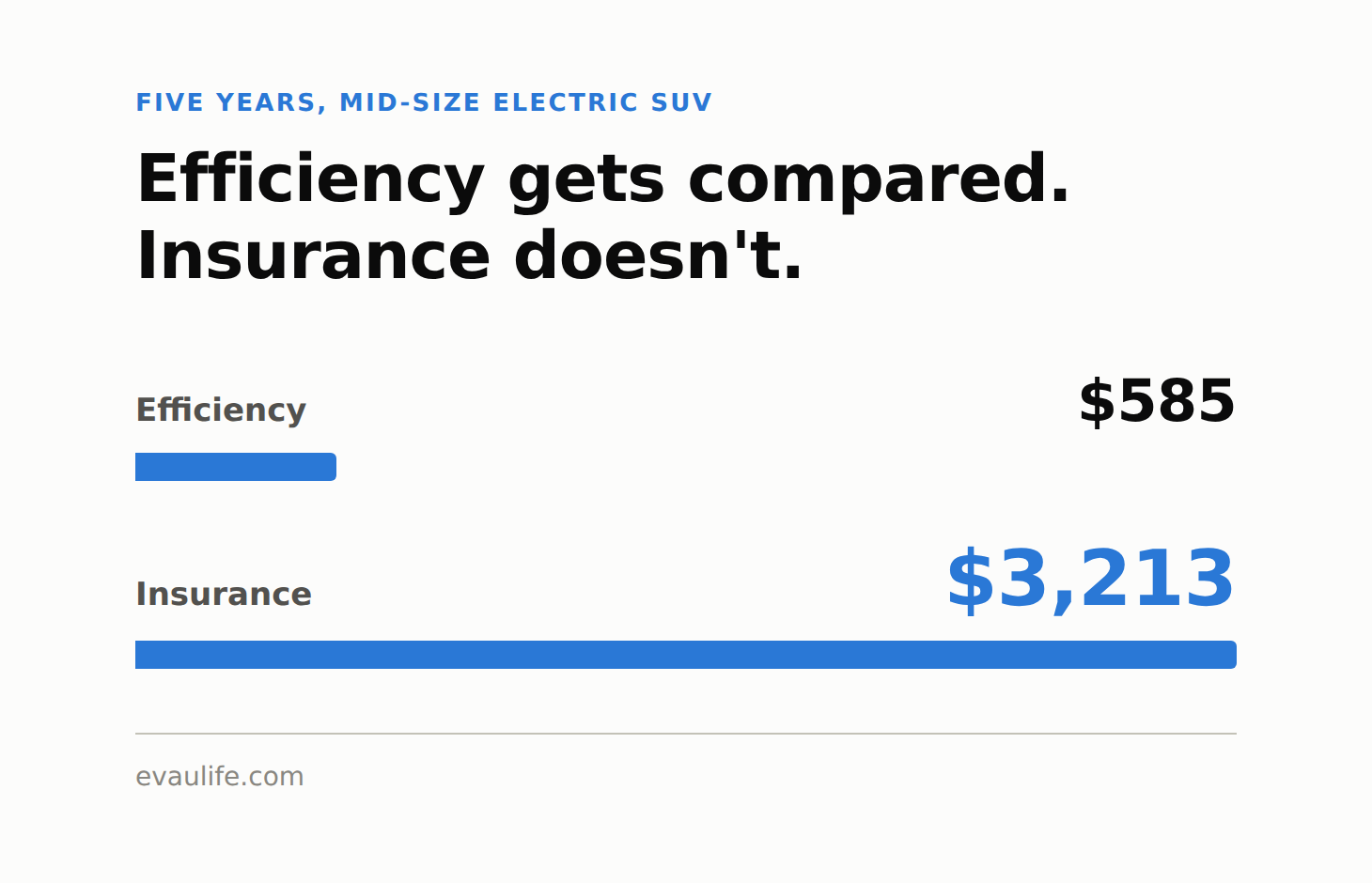
Every time I’ve looked up the cheapest EV in Australia, the comparison comes down to range and efficiency. Kilowatt-hours per hundred kilometres, WLTP figures, real-world range tests. Efficiency is the one that turns into money every week you own the car, so I sat down to work out what the spread across the segment is actually worth.
About $117 a year.
Meanwhile there’s a line item in this segment that separates the cheapest brand from the dearest by $1,363 in the car’s first year, and I have never seen it in a comparison table.
One thing to set up front: this is about mid-size electric SUVs, which is where most of the volume sits. Smaller and cheaper EVs are on sale here and they will beat every purchase price below.
On this page
- What everyone compares, and what it’s worth
- The column nobody puts in the table
- Five years of ownership, in Sydney
- What CHOICE says drives the gap, and what it doesn’t explain
- The brands that aren’t in the data yet
- What it actually costs to charge
- The number I can’t give you
- So which one is actually cheapest
- Common questions
What everyone compares, and what it’s worth
Getting comparable consumption figures for these cars is harder than it should be, so start with the two I could pin down.
The Geely EX5 Complete is declared at 16.0 kWh per 100 km on the WLTP cycle. The BYD Sealion 7 Premium is declared at 19.9. BYD Australia’s own page publishes range and no consumption figure, but the 19.9 turns up as the manufacturer’s declared value in Green NCAP’s assessment of the same car, so the two numbers sit on the same basis and can be compared.
Drive 15,000 km a year, which is above the national average of roughly 12,000 but close to what a metro new-car buyer does, and that’s 2,400 kWh against 2,985 kWh. At an off-peak home tariff of about 20c/kWh, $480 a year against $597.
$117 a year. Two dollars twenty-five a week.
The Tesla Model Y RWD is the one I couldn’t place. Australian sources quote it at 13.9, which would stretch the gap to $180 a year, but 13.9 doesn’t square with the 466 km of WLTP range the same sources give it on a 60 kWh battery. One of those two numbers is on a different basis from the other, and I couldn’t work out which, so I’ve left it out of this comparison.
Worth knowing that WLTP consumption is measured from the wall, so it already includes the energy lost in charging, and it is still optimistic. Green NCAP drove the Sealion 7 and recorded 21.45 kWh/100 km on a mixed route, against the declared 19.9. Everything below scales linearly, so knock a fifth off if you drive the national average, or double it at 30,000 km. Charge exclusively on public rapid chargers and multiply by roughly three, four if you’re unlucky with the charger.
For a normal private buyer doing normal kilometres, the number that dominates every comparison table is worth under ten dollars a month.
The column nobody puts in the table
Insurance, and the spread is enormous.
CHOICE publishes average annual premiums by brand for new electric vehicles, drawn from a January 2026 sample of more than sixteen thousand EV quotes across all vehicle ages:
| Brand | Average annual premium, new EV |
|---|---|
| Geely | $1,622 |
| Kia | $1,774 |
| BYD | $2,220 |
| BMW | $2,706 |
| Tesla | $2,985 |
For scale, CHOICE puts the average across every new EV in its sample at $2,440, against $1,865 for a new petrol car. That $2,440 covers the whole new-EV sample, not just the five brands above, so don’t read it off the table.
The gap between the cheapest brand here and the dearest is $1,363 in the first year. Set that against the $117 efficiency gap and insurance is worth more than eleven times as much.
I’ve put “first year” in that sentence deliberately, because premiums move with age and the five-year picture is different. I’ll come back to it below. Even on the five-year numbers, insurance is worth more than five times what efficiency is.

Two warnings before leaning on any of this. These are brand averages, so CHOICE’s BYD figure blends a $30,000 Dolphin with a $55,000 Sealion 7, and its Kia figure blends a Niro with an EV9. And CHOICE gathered them across a wide spread of driver profiles at a standardised excess, which makes them good for ranking brands and useless as a quote for you personally.

Five years of ownership, in Sydney
Three cars, all from brands CHOICE covers, in NSW.
| Model | List price | NSW stamp duty | Rego, 5 years | Insurance, 5 years | Five-year total |
|---|---|---|---|---|---|
| Geely EX5 Complete | $41,990 | $1,260 | $6,650 | $10,498 | $60,398 |
| BYD Sealion 7 Premium | $54,990 | $1,850 | $6,650 | $9,860 | $73,350 |
| Tesla Model Y RWD | $58,900 | $2,045 | $6,650 | $13,711 | $81,306 |
The insurance column is a brand average applied to a specific model, so read the totals as ranking these cars, not as pricing them.
That column is where most five-year comparisons quietly cheat. They take today’s new-car premium and multiply by five. CHOICE publishes separate tables for new, one, two, three and four-year-old cars, and premiums don’t hold still across them. Tesla’s trend down, from $2,985 new to $2,633 at four years old, which totals $13,711. BYD’s fall further and more steadily, $2,220 down to $1,754, for $9,860.
Geely is the awkward one. CHOICE has it at $1,622 new and $2,219 at one year old, and nothing after that, because there weren’t enough quotes available to average. I’ve held that $2,219 across years two to five, which gives $10,498. That is a guess, and it’s worth being clear about how big a guess: $8,876 of the Geely’s $10,498 comes from repeating a single CHOICE cell four times. Of the five brands in the table above, two get cheaper as the car ages and three get dearer, Kia sharply so, and I have no way of knowing which pattern a Geely follows. Flat sits between the two, and it is $2,388 more than you’d get by multiplying the new-car premium by five.
There’s a genuinely surprising thing buried in those two Geely figures. Geely is the cheapest brand here to insure while the car is brand new, and by one year old BYD is cheaper. The cheapest car to insure and the cheapest brand to insure are not the same question, and neither is settled by a premium quoted on day one.
Stamp duty at the NSW passenger vehicle rate, computed on the list price. Registration is $84 plus $596 motor vehicle tax for the tare weight band all three cars fall into, plus $650 for a green slip, which is a Sydney estimate. Insurance from CHOICE, by brand, at the vehicle ages CHOICE publishes. Charging is out, to keep this to the fixed costs. Dealer delivery and plates are out too: they aren’t a flat add-on, they run higher on the Tesla than the Geely on published Sydney drive-away prices, and NSW levies duty on what you actually pay, so both my duty figures and the gap below are slightly understated. NSW’s proposed road user charge, due from 1 July 2027, is out: it would add a few hundred dollars a year to every row from year three, and it lands on all three cars identically, so it moves no gap here. Depreciation is out entirely, for reasons further down.
One caveat that will date faster than the rest of that table. BYD is running a drive-away campaign on the Sealion 7 Premium for orders placed between 1 August and 30 September 2026 and delivered by 31 October, which covers the on-road costs. Against my table that’s worth $3,180, the stamp duty plus the first year’s registration, bringing the BYD to $70,170. In practice it’s worth more, because it also covers the dealer delivery and plates I’ve left out. It doesn’t change the order. Campaigns like this come and go across every brand here, so check what’s actually running before you lean on any table, this one included.
On the windscreen, the Tesla is $16,910 more than the Geely. Over five years it’s $20,908 more.
Insurance accounts for $3,213 of that widening and stamp duty for another $785. The number people spend weeks negotiating over misses about 19 per cent of the real difference.
Among these three the ranking holds. The cheapest car to buy is also the cheapest to own. What changes is the size of the gaps, and the gaps are what people are actually deciding between. Widen the set and it stops being settled: I’ve worked a Kia EV5 through in my ranking of the best EV SUV in Australia, where the BYD finishes ahead on list prices either way you treat the insurance data, and the Kia finishes ahead once you use what the two brands are actually advertising this month
The cars I had to leave out are the interesting ones. Zeekr, XPeng and Leapmotor are missing from CHOICE’s data entirely, and between them they cover a lot of what’s in showrooms. The Zeekr 7X starts at $57,900, a thousand dollars under the Tesla, and Drive named it best medium SUV under $60,000 at its 2026 Car of the Year awards. I can’t put a five-year number on it.
What CHOICE says drives the gap, and what it doesn’t explain
CHOICE puts the brand differences down to the price tier of the brand, the availability and price of spare parts and service centres, and the theft rate and safety equipment of the car itself.
The parts factor is the one people reach for first, and for electric vehicles in Australia it’s easy to believe. The network is still thin, components often ship from overseas, and repairs need technicians with high-voltage training. A panel shop that can fix a Corolla cannot necessarily touch a battery pack.
That explains why electric cars cost more than petrol ones. It doesn’t explain the $1,363 between Geely and Tesla, and CHOICE doesn’t break those factors down brand by brand, so I can’t tell you which one is carrying that gap. The parts story in fact points the wrong way here: Geely’s Australian network is newer and thinner than Tesla’s, and Geely is the cheaper one.
The brands that aren’t in the data yet
CHOICE’s explanation for the missing brands is a sampling one. If a brand isn’t there for a given vehicle age, there weren’t enough quotes available to average. That’s a limit on what CHOICE could collect, not on what insurers know. Geely started selling cars here after Zeekr did, and Geely still turns up in the one-year-old table at $2,219 while Zeekr appears in none of the five, so being new isn’t on its own what keeps a brand out.
For a buyer this creates a real and annoying gap. Cross-shop an established brand against a new one and you can look up a benchmark for one and not the other.
Something else to sort out before you start: insurers price by exact variant, not by model, because trim levels within one nameplate can sit in different rating groups. Get the wrong one in the dropdown and the number you’re comparing is meaningless. Any dealer can give you the precise variant and build year in about a minute, and if the car you can’t find data for is a Zeekr and you’re on the north shore, Zeekr Chatswood can read it off a specific build for you.
Then get three quotes on each car, before you commit. Two things come out of that. Insurers disagree with each other about the same car, sometimes substantially, and that difference is money you keep by shopping. And it’s the only way to find out where a brand CHOICE hasn’t covered actually sits, which on this segment’s numbers is a difference of thousands across five years.
What it actually costs to charge
Here’s five years of charging for a mid-size electric SUV at 17.8 kWh/100 km, near the midpoint of the two cars above, doing 15,000 km a year. Public rates are the cheapest and dearest per-kWh prices across five Sydney networks, sampled at peak time on 15 July 2026. Home rates are my reading of current NSW retailer offers, not a survey.
| How you charge | Rate | Five years |
|---|---|---|
| Home, off-peak time-of-use | 18 to 22c/kWh | $2,403 to $2,937 |
| Home, single flat rate | 33 to 35c/kWh | $4,406 to $4,673 |
| Public fast charging only | 59 to 79c/kWh | $7,877 to $10,547 |
One thing about that 59c: it’s a 50 to 75kW rate. On a genuine 150kW-plus rapid charger the Sydney range is 70 to 79c, so the cheap end of the bottom row assumes you’re happy to sit there a while.
Charging at home overnight against relying on public chargers is worth $4,940 to $8,140 over five years. That is more than eight times the efficiency gap between those two cars, and bigger at both ends than the $3,213 insurance gap in my table.
Look at the middle row too, because it’s where a lot of people actually are. Charging at home on a single flat rate instead of an off-peak plan costs $1,470 to $2,270 across five years, more than twice the entire efficiency question, for being on the wrong electricity plan.
One thing this doesn’t say. Where you charge doesn’t outweigh which car you buy: the sticker gap between the Tesla and the Geely is $16,910 on its own, more than the insurance and charging spreads put together. What it does outweigh is the two things buyers spend their research time on, which are range and efficiency. I got to the same place from a different angle in the full NSW running cost breakdown, though that one runs on the same tariff assumptions as this one, so treat it as the argument extended and not as independent confirmation.
The number I can’t give you
There’s a hole in everything above, and it’s a big one: depreciation.
For most cars it’s the single largest cost of ownership, bigger than fuel, insurance and servicing combined. A car that loses $30,000 in resale value over five years has cost you more in depreciation than the stamp duty, registration and insurance in my table put together.
I’ve left it out because I don’t have honest numbers for it. Resale values come from watching what cars actually sell for after a few years, and a lot of this segment hasn’t been here long enough to watch. Tesla has a decade of Australian resale history. BYD has a few years. Geely, Zeekr, XPeng and Leapmotor have only been selling cars here for a year or two, so there is no five-year used market to look at, because there are no five-year-old ones.
I’d rather say that plainly than model it and pretend. If you see a five-year cost comparison that confidently includes resale value for a brand that’s been here two years, someone has put a number in a spreadsheet that nothing supports.
In practice that means the newer the brand, the more of your total cost sits in a figure no one can quote you yet. That’s a real risk, and it deserves weighing against a cheaper sticker price.
So which one is actually cheapest
On the numbers above, the Geely EX5 Complete, at $60,398 over five years against $81,306 for a Tesla Model Y RWD.
I’d hold that loosely. The cost I couldn’t put in the table is the one large enough to overturn it, and for a brand with no five-year used market nobody can tell you which way it points.
What I’d take from this is the method. The two figures on the window sticker, the price and the efficiency number, tell you less than you think. Price is real and it still separates these cars by more than anything else I could count, but on its own it misses about 19 per cent of the five-year gap. Efficiency, between the two cars I could measure the same way, is worth $117 a year.
So before you spend another evening reading range tests: get insurance quotes on your shortlist, and work out whether you can charge at home overnight. Those two answers will move your five-year cost by more than anything else you can still change once you’ve picked the car.
Common questions
What is the cheapest EV to own in Australia?
Among mid-size electric SUVs, on five-year costs including stamp duty, registration and insurance, the Geely EX5 Complete works out around $60,398 in NSW, against $73,350 for a BYD Sealion 7 Premium and $81,306 for a Tesla Model Y RWD. Purchase price and five-year cost rank in the same order, but the gaps are wider than the sticker prices suggest. Those totals use brand-average premiums, so treat them as a ranking and not as a quote. Smaller EVs than these will beat all three on purchase price.
Is insurance more expensive for electric cars?
Yes. CHOICE’s January 2026 quotes put the average new EV at $2,440 a year against $1,865 for a new petrol car. The spread between EV brands is larger than that gap: $1,622 a year for Geely, $2,220 for BYD and $2,985 for Tesla.
Does a more efficient EV save much money?
Less than most people expect. Between the two mid-size electric SUVs I could compare on the same declared WLTP basis, 16.0 against 19.9 kWh/100 km, the difference is about $117 a year at 15,000 km on an off-peak home tariff. Around $2.25 a week.
Why isn’t Zeekr or XPeng in the insurance data?
CHOICE says only that there weren’t enough quotes available for those brands at that vehicle age. You’ll need individual quotes, and insurers will want the exact variant and build date before they’ll price it.
What matters most for EV running costs?
Whether you can charge at home on an off-peak tariff, which is worth $4,940 to $8,140 over five years against relying on public fast chargers. That’s more than eight times the efficiency difference between the cars. Insurance matters at a similar scale, though I can tell you what the brands differ by and not what you’d save by shopping, since no one publishes that. Neither beats the purchase price, which separates these cars by more than every cost I could count put together. Depreciation, which I couldn’t count, may not follow that pattern.
Leave a Reply