Two people on identical salaries sign the same novated lease electric car contract on the same day, through the same provider, on the same terms.
Over five years the first comes out $27,209 better off than if she’d bought the car with a loan. The second comes out $16,259 better off, and her super is $9,125 lighter on top of that.
Nothing about the car explains the gap. It is three things that never appear on a novated lease quote: whether you carry a HELP debt, whether you hold private hospital cover, and how your employer works out your super.
This is what a novated lease electric car arrangement in Australia is actually worth, once those three are counted.
On this page
How a novated lease electric car saves you money
A novated lease is a three-way arrangement. You choose a car, a financier buys it, and your employer takes the payments out of your salary before tax is calculated. When you leave, the arrangement unwinds and the car comes with you.
It is cheaper than buying the car yourself for two reasons.
The first is GST. The financier claims the GST credit on the car and your employer claims it on the running costs, so the money that comes out of your pay is the price without GST. On a $60,000 car that is $5,455 off the amount financed before anything else happens.
There is a ceiling on that, and no quote will mention it. For 2026-27 the car limit is $69,883 and the most GST anyone can claim back on a car is $6,353. Above that price the excess is financed like any other cost: an $89,400 car carries $8,127 of GST and only $6,353 comes off, leaving $1,774 you pay interest on for five years. Holding a car for lease does not get you an exemption from the cap.
The second is the FBT exemption for electric cars. Package a petrol car and your employer is up for fringe benefits tax, which normally gets handed back to you as a post-tax contribution. Package an eligible electric car and there is no FBT, so the whole lot can come out of pre-tax salary. That is the part that makes electric cars worth packaging when petrol cars often aren’t.
Four conditions have to be met. The car has to be battery electric or hydrogen fuel cell. Plug-in hybrids stopped counting on 1 April 2025, though an arrangement that was already financially binding before that date can continue. The car has to have been first held and used on or after 1 July 2022. It has to be used by a current employee or their family. And luxury car tax must never have been payable on it, which for 2026-27 means a value under $91,661.
There is also a definition worth knowing, because it catches people out. For FBT purposes a car carries a load under one tonne and eight or fewer people including the driver. Some dual-cab utes fall outside that.
Here is the worked example that the next few sections run off. A $60,000 car including GST and delivery, a five year lease at 7 per cent, $4,900 a year of running costs bundled in, on a $100,000 salary.
| Car price including GST | $60,000 |
| Less the GST credit | -$5,455 |
| Amount financed | $54,545 |
| Lease payments a year | $10,389 |
| Running costs a year, after the GST credit | $4,516 |
| Management fee | $300 |
| Comes out of pre-tax salary each year | $15,205 |
A note on the running cost line, because the division doesn’t look right at first. Registration and motor vehicle tax carry no GST, so the credit only comes off the rest. On $676 of GST-free registration, the credit runs on the remaining $4,224 and comes to $384, which is why $4,900 becomes $4,516 and not $4,455. The one-off establishment fee is not in the table either. Expect $300 to $700 for that, charged at the start.
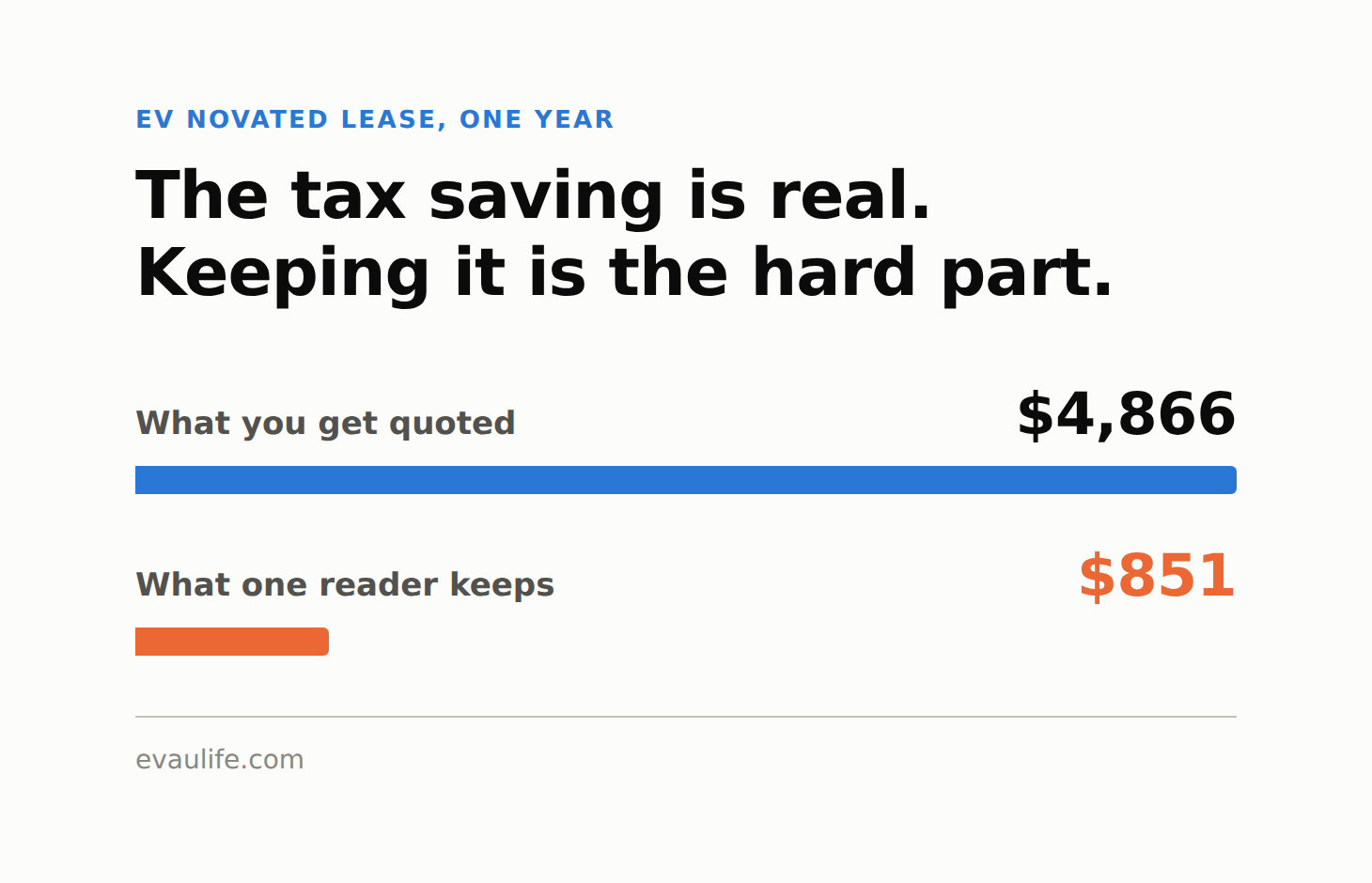
At $100,000 the marginal rate including the Medicare levy is 32 per cent, so packaging $15,205 saves $4,866 a year in tax.
That is the number a provider will quote you. It is correct, and it is not what you keep.
The number that gets added back
An exempt car is still a reportable fringe benefit. Your employer pays no FBT on it, but they still have to work out what the taxable value would have been and put the grossed up figure on your income statement.
The formula is 20 per cent of what the car cost, multiplied by 1.8868. In a full year that lands just under 38 per cent of the car’s value. Packaging less of the lease pre-tax does not shrink it, because it is driven by the car rather than by how much salary you sacrifice. Paying part of the cost with after-tax money does shrink it, which matters later.
On a $60,000 car it is $22,642.
Two refinements the five-year totals below gloss over. FBT years run to 31 March, so a lease starting mid-year straddles six of them with a part year at each end, and the first and last years’ figures are smaller. And once the car has been held for four full FBT years the base value drops by a third, which pulls the reportable amount down late in the term. Both work in your favour, so the totals below are the pessimistic reading.
That amount is not taxed. It does, however, get added back to your income for a long list of government tests, including HELP repayments, the Medicare levy surcharge, the private health insurance rebate, Division 293, Family Tax Benefit and the Child Care Subsidy.
Put those two numbers next to each other. Packaging takes $15,205 out of your taxable income and puts $22,642 back into the income you get tested on. The figure your HELP repayment is worked out on goes up by $7,437.
### If you have a HELP debt
Repayment income is your taxable income plus reportable fringe benefits, along with reportable super contributions, investment losses and exempt foreign income. The 2026-27 scale runs nil to $69,528, then 15 cents in the dollar to $129,717, then $9,028 plus 17 cents to $186,050, then a flat 10 per cent of the lot. The rate in this example’s range is 15 cents.
Fifteen cents on that extra $7,437 is $1,116 a year. Your salary fell and your student loan repayment rose.
### If you don’t hold private hospital cover
The Medicare levy surcharge is tested on the same broadened income. On $100,000 flat there is no surcharge, because the singles threshold is $105,000. Drop your taxable income to $84,795 and add $22,642 of reportable benefits and you are at $107,437, which is over the line.
The surcharge is one per cent of taxable income plus reportable benefits, so $1,074 a year. You are paying a levy aimed at people earning more than you do.
Buying hospital cover instead of paying the surcharge is usually the better answer, but check the premium against your own figure rather than assuming, because $1,074 is not far off what a basic single policy costs. And if you do buy cover, the same reportable amount drops you a tier on the rebate, so the swap is not quite as clean as it looks.
### The one your payroll decides
This is the largest of the three and the least discussed.
Super is calculated on ordinary time earnings, and a novated lease is not part of them. The ATO’s list of payments that count as ordinary time earnings puts it plainly: “Salary sacrificed to other employee benefits, including amounts that are fringe benefits and exempt fringe benefits” counts as neither salary and wages nor ordinary time earnings. An exempt electric car is exactly that. Your employer is allowed to work out super on your salary after the lease comes off.
The rule change in January 2020 that stopped employers counting sacrificed super towards their obligations does not help here, because it only added sacrifice into superannuation back to the base. A car is not super.
Plenty of employers keep paying on the full figure. It is a policy rather than a law, though, and at 12 per cent of $15,205 the difference is $1,825 a year, or $9,125 across a five year lease.
One email to payroll answers it. Ask whether super guarantee is calculated on pre-sacrifice or post-sacrifice salary, and get the answer before you sign rather than after.
What that does to the $4,866
| No HELP debt, hospital cover | HELP debt, no hospital cover | |
|---|---|---|
| Tax saved on the packaged amount | $4,866 | $4,866 |
| Extra HELP repayment | $0 | -$1,116 |
| Extra Medicare levy surcharge | $0 | -$1,074 |
| Employer super you stop getting | $0 | -$1,825 |
| What you actually keep | $4,866 | $851 |

One reader keeps all of it. The other keeps 17 per cent of it. Neither is a floor: add Family Tax Benefit or the Child Care Subsidy near a taper and the answer can go below zero.
Most people land in between. A HELP debt on its own leaves you with $3,750. On $160,000 with a HELP debt and hospital cover, the higher marginal rate lifts the saving to $5,930 and the HELP hit rises to $1,264, so you keep $4,666.
That table also leaves out family payments. If you receive Family Tax Benefit or the Child Care Subsidy, the same $22,642 is counted in those income tests too, and for a household near a taper it can cost more than all three of the items above combined. Run your own figures before you commit.
### The workaround that doesn’t work
There is an obvious-looking way out, and it is worth explaining why it fails.
The ATO’s fact sheet on electric vehicles confirms that electricity, registration, servicing and tyres you pay for yourself out of after-tax money count as recipient contributions and come straight off the taxable value. This is the one thing that does move the reportable figure, and because that figure is grossed up, $1,000 paid personally knocks $1,887 off it. So you would think a HELP debtor should pay the running costs themselves and shrink the problem.
Run it and you lose. Take $1,000 of running costs out of the package and pay it yourself, and you give up the GST credit on it plus the 32 per cent tax relief, worth $382 together. Back comes 15 cents in the dollar on $1,887 of reportable benefit, which is $283, and then the extra repayment on your now higher taxable income takes $136 of that away again. You are about $235 a year worse off for every $1,000 you move.
There is a second version of the same idea that loses less. Instead of paying a running cost yourself, pay the employer a straight post-tax contribution. It comes off the taxable value the same way, so $1,000 still drops the reportable figure by $1,887, but you keep the GST credit. You give up $320 of tax relief, get $283 back on the repayment, then hand $150 of it straight back because your taxable income is now $1,000 higher. Net cost about $187 for every $1,000, against $235 the other way. Better, still negative.
The surcharge cliff is the only place it can pay, and even there it is fiddly. You have to shed $2,437 of tested income to get back under $105,000, and because paying a cost yourself also pushes your taxable income up, it takes about $2,500 of running costs to do it. Move $2,400 and you are still $90 over the line, paying the surcharge anyway and $541 down on the year. Clear it properly and a reader with a HELP debt is $486 ahead, one without is $120 ahead. Buying hospital cover is the simpler answer. Otherwise leave the costs in the package.
The bill at the end
Every lease ends with a residual, and it is the one number the weekly figure hides.
The minimum residuals are published in ATO ID 2002/1004, on a scale tied to the asset’s effective life. A car has an eight year effective life, which gives 46.88 per cent at three years, 37.5 at four and 28.13 at five. TD 93/142 is a separate determination dealing with whether you can go below the published scale, not the source of it.
Neither document says whether the percentage runs on the price with GST or without it. The industry works it on the amount financed, which is GST-exclusive, and then charges GST on the payout because buying the car off the financier is a sale. On our example that is 28.13 per cent of $54,545, so $15,344, and a cheque of $16,878.
Get the basis in writing, because there is a third route that is not the same. Run the percentage on the $60,000 including GST and then add GST on top and the cheque is $18,566. That is $1,688 of surprise, and I have seen the figure quoted that way.
None of that can come out of pre-tax salary. It is the one part of the arrangement with no tax benefit at all, and it arrives as a lump sum five years after you signed the paperwork.
One condition worth knowing before you ask for it in writing. For the arrangement to be a car benefit at all, and therefore to be covered by the electric car exemption, the lease cannot contain an agreement that you will buy the car at the end or keep using it afterwards. Buying it has to be an option you exercise, never a term written into the lease. A provider that offers to lock in the purchase up front is offering to break the thing that makes this work.
A shorter term does not get you out of it, and it is dearer along the way. A three year lease on the same car takes $17,342 a year out of your salary instead of $15,205, and still leaves a bigger residual at the end: $25,571, or $28,128 once GST goes on.
The rate you have to ask for
Providers quote a weekly or monthly figure with everything bundled together. That number is easy to compare against your current spending and almost impossible to compare against another provider.
Ask for three things in writing: the interest rate as a comparison rate, the amount financed, and the residual. Nobody publishes an industry benchmark for this, so treat any range you are quoted, including mine, as a starting point for haggling and not a market rate. Monthly management fees run $15 to $30 and establishment fees $300 to $700, and those are usually inside the quote rather than beside it.
Then settle these before you sign.
A home charger is not covered. The exemption runs to the car and its running costs, including the electricity, but if your employer buys or reimburses a charging station that is a separate fringe benefit and it is taxed. The ATO is explicit that a charging station “is not a car expense”.
The electricity itself is covered, and there is a shortcut for working out how much of your home power bill counts. PCG 2024/2 lets you use a flat rate per kilometre instead of separating the car’s consumption from the household’s. For the FBT year ending 31 March 2027 that rate is 5.47 cents per kilometre, up from 4.20 cents, a 30 per cent rise that most guides still have not picked up. You need odometer records and at least one electricity bill, and the choice between the flat rate and actual cost is made per car for a whole year.
If you leave your job the novation ends. The lease does not, and the payments revert to you out of post-tax income until you novate it to a new employer or pay it out. If your work is contract based or your industry is going through a rough patch, price that risk before you take a five year term.
Insurance is worth pricing separately too, because it is bundled into the package and it varies more between brands than most people expect. I went through what the differences actually cost across a five year hold when comparing the cars themselves.
What actually changes in 2027 and 2029
You will read that you have until 31 March 2027 to lock this in. For most buyers that is not what the change says.
The government announced in May 2026 that the concession will be delivered through the FBT statutory formula rate instead of an exemption, in three steps. The measure is not yet law.
| From | Cars at or under $75,000 | Cars over $75,000, under the LCT threshold |
|---|---|---|
| Now to 31 Mar 2027 | No FBT | No FBT |
| 1 Apr 2027 to 31 Mar 2029 | Still no FBT | FBT applies, cut by a quarter |
| 1 Apr 2029 onwards | FBT applies, cut by a quarter | FBT applies, cut by a quarter |
The middle row is the one that gets misread. A car over $75,000 does not lose a quarter of its benefit from April 2027. It loses about three quarters of it, because it goes from paying no FBT at all to paying FBT with a 25 per cent discount.
So if the car you want is under $75,000, nothing gets worse for you in March 2027. The date that matters is 31 March 2029. If the car is over $75,000, March 2027 is real and it is expensive.
Existing leases are said to be protected, though the legislation that would say so precisely has not been drafted. Neither has the detail of how the $75,000 is measured, or whether it gets indexed.
There is a second question buried in that mechanism, and it cuts the other way. The reportable amount is worked out off the statutory percentage, and for cars under $75,000 the announced percentage from April 2027 is zero. Whether the reportable figure follows it down to zero, taking the HELP and surcharge problems with it, is not something anyone has answered yet. A lease signed today locks in today’s treatment for its whole term, so this is not a reason to wait on a maybe. It is a reason to ask the question, because for anyone with a HELP debt it is the part of the 2027 change that actually matters, and no quote will raise it.
### Which cars sit either side of the line
List prices, before on-road costs.
Under $75,000, so unaffected until 2029
| Model | List price |
|---|---|
| Geely EX5 Complete | $41,990 |
| XPeng G6 RWD Standard Range | $51,800 |
| BYD Sealion 7 Premium | $54,990 |
| Zeekr 7X RWD | $57,900 |
| Tesla Model Y RWD | $58,900 |
| Zeekr 7X Long Range RWD | $63,900 |
| Tesla Model Y Long Range AWD | $68,900 |
| Kia EV6 Air RWD | $72,660 |
| Zeekr 7X Performance AWD | $72,900 |
| Tesla Model Y L Premium AWD | $74,900 |
Over $75,000, so a quarter concession from April 2027
| Model | List price |
|---|---|
| Kia EV6 GT-Line RWD | $79,660 |
| Kia EV6 GT-Line AWD | $87,660 |
| Tesla Model Y Performance | $89,400 |
The line cuts through trim levels rather than brands. A Kia EV6 Air keeps the full concession and the GT-Line seven thousand dollars above it does not. The Tesla Model Y L comes in $100 under the cap, which is close enough to be nervous about. The Zeekr 7X in Performance trim is the quickest car on the list that still lands under the line, at $72,900.
Treat the table as provisional at the edges. The measurement basis for the $75,000 has not been set, so anything within a couple of thousand dollars of the line could move. The luxury car tax test uses the price including dealer delivery, so cars listed in the high eighties can fall either side of $91,661 depending on the dealer.
I’ve also worked through what these same cars cost to own outright over five years, which is a different question with a different answer.
So is a novated lease worth it
On the numbers above, yes, and by a wide margin.
Over five years the reader with no HELP debt and hospital cover spends $68,575 of take-home pay and owns the car, against $95,784 doing the same thing with a car loan at the same 7 per cent. That is $27,209 ahead, less the $300 to $700 establishment fee, which is not in any of these figures. The reader carrying a HELP debt and no hospital cover is $16,259 ahead, and if payroll also drops the super, another $9,125 comes off that.
Neither of those is a floor. Family payments are the missing row, and near a taper they can cost more than everything above combined.
An EV novated lease works. What varies is by how much, and the variation is large enough that “it saves you tax” is not a useful answer to anybody.
It works best if you are on a high marginal rate, you have no HELP debt, you hold hospital cover, your employer maintains super on your full salary, you receive no family payments, your job is stable for the length of the term, and you intend to keep the car at the end.
It gets much thinner when several of those are false at once, particularly on a lower marginal rate with an employer who takes the super saving and a family payment in the mix. On the figures above it stays ahead of a car loan even with every drag counted, but the margin is a fraction of the headline.
So before you sign: ask payroll how super is calculated, work out what the reportable amount does to your HELP repayment, your surcharge and any family payments, and get the comparison rate and the residual in writing. Then decide how you will find the residual in five years, because nobody is going to remind you about it.
If you are cross-shopping specific builds on the north shore, Zeekr Chatswood can give you the exact variant and build date, which is what a lease provider and an insurer will both ask for before they will quote you properly.
Common questions
Is a novated lease worth it in Australia?
For an eligible electric car, usually yes. On a $100,000 salary with a $60,000 car it works out between $16,259 and $27,209 better than a car loan over five years, depending on whether you carry a HELP debt and whether you hold hospital cover. If your employer also drops your super to the post-lease figure, take another $9,125 off the bottom of that range.
Does a novated lease affect my HELP repayment?
It can increase it. Your taxable income falls, but the reportable fringe benefits amount gets added back for the repayment test, and that amount is 20 per cent of the car’s value grossed up by 1.8868. On a $60,000 car packaged over five years it is $22,642 added against $15,205 taken out, so repayment income rises by $7,437 and the repayment by about $1,116.
Do I pay FBT on an electric car novated lease?
Not at the moment, if the car is battery electric or hydrogen, was first used on or after 1 July 2022, and has never attracted luxury car tax. From 1 April 2027 cars over $75,000 start paying FBT with a 25 per cent discount, and from 1 April 2029 every eligible car does.
What is the residual on a five year novated lease?
28.13 per cent of the amount financed, which is the ATO minimum. On a $60,000 car that is $15,344 plus GST, so $16,878 payable at the end. It cannot be paid from pre-tax salary.
Do I have to sign before 31 March 2027?
Only if the car is over $75,000. Under that price you keep paying no FBT until 31 March 2029 under the announced changes, though the mechanism switches from an exemption to a zero per cent statutory rate in April 2027. None of it is law yet.
Leave a Reply