Every EV comes with a pitch for a wallbox, and the case sounds obvious: proper charger, proper speed, done overnight. Type home EV charger Australia into a search bar and you get installer pages quoting each other’s numbers, so I went to the sources and did the arithmetic myself.
The costs were straightforward. The answer to whether you need one was not.
On this page
- Start with what your house has, not what the charger can do
- What a 7 kW install involves, and who you have to tell
- Home EV charger Australia: what it costs
- There is money available for this, and almost nobody mentions it
- Now the part I didn’t expect
- Before you rely on the cable, spend $150
- The solar question, which is oversold
- One thing NSW doesn’t ask for
- So what would I actually do
- Common questions
Start with what your house has, not what the charger can do
Australian homes are wired for single-phase or three-phase supply, and that sets your ceiling before you choose any hardware. Tesla publishes the rates for its own cars in Australia:
| Supply | Power | Range added per hour, Model 3 |
|---|---|---|
| 10A single-phase power point | 2.3 kW | 15 km |
| 16A single-phase | 3.5 kW | 25 km |
| 32A single-phase | 7.4 kW | 50 km |
| 16A three-phase | 11 kW | 75 km |
Treat the kilometre column as an upper bound, not a rule. Tesla’s own table gives different figures for different Teslas: the same 2.3 kW that adds 15 km an hour to a Model 3 adds 11 km to a Model X. A heavier, thirstier car does worse again. The kilowatt column is the reliable half.
Three-phase at 32 amps gets you 22 kW, which is arithmetic rather than something Tesla publishes. Most Australian houses are single-phase, which caps you at 7.4 kW no matter what you bolt to the wall. Bringing three-phase in is a distributor job and a different order of expense.
There’s a second ceiling, on the car. A 22 kW charger only delivers 22 kW if the car’s onboard AC charger can take it, and plenty of EVs top out at 7 kW or 11 kW on AC no matter what they’re plugged into. It’s worth confirming for the exact variant before spending up on a three-phase unit. Any dealer can read it off a specific build; on the north shore, Zeekr Chatswood will have it for a 7X. The caps are lowest in the small car segment, where four of the eleven cars on sale are stuck at 6.6 kW. We tabled them in the best small electric car in Australia.
What a 7 kW install involves, and who you have to tell
A wallbox is a dedicated circuit, not an appliance you plug in. In practice: a dedicated run from the switchboard, an appropriately rated breaker and RCD, the cable run, and enough spare capacity in the board to carry it.
On the RCD, there’s a widely repeated claim that EV chargers need an expensive Type B device. The Electric Vehicle Council’s installation guideline is more precise: “a type A RCD is acceptable if the EVSE can ensure disconnection of the supply in case of DC fault current above 6mA. If the EVSE doesn’t have this capability, a type B RCD is called for.” Many units sold here have that detection built in, so ask rather than assuming you need the expensive one.
Your electrician will probably have to tell your distributor, and this is the part people skip.
Essential Energy is the blunt one. A Level 1 plug-in cable needs nothing: “You do not need to submit a connection application for Level 1 charging.” A Level 2 charger is different: “You will need to update your current connection offer with Essential Energy”, done by your electrician lodging a new connection application. Essential defines Level 2 as “between 8kW up to 22kW”, so a 7.4 kW wallbox sits just underneath and a three-phase unit is squarely inside.
Endeavour Energy publishes a threshold too: “Chargers above 7 – 10 kW or those needing a new circuit may require an application to Endeavour Energy.” It also states that “any installation of a level 2 charger will require a licenced electrician to reassess your maximum demand, which may require an upgrade of your connection.”
Ausgrid is the vaguest: you “may be required to notify Ausgrid before installing so that we can assess the impact.”
The obligation sits with your electrician, not with you. But it’s worth asking whether they’ve lodged it, because in Essential’s area it isn’t optional.
### One correction, because it’s everywhere
A lot of Australian installer pages tell you Section 7.9 of AS/NZS 3000:2018, the Wiring Rules, governs EV charging here. It doesn’t. The heading of Section 7.9 reads “SUPPLIES FOR ELECTRIC VEHICLES (NZ ONLY)”.
What applies in Australia is Appendix P, which is informative rather than normative. That doesn’t make it optional in practice: it’s the recognised guidance, and an electrician departing from it needs a reason. But there is no mandatory EV-specific clause in the Wiring Rules, and the binding requirements come from the general rules on circuit protection, RCDs and maximum demand plus your distributor’s connection rules. If a quote says “Section 7.9 requires”, the quote is citing New Zealand. Amendments 1, 2 and 3 don’t change it.
Home EV charger Australia: what it costs
Hardware first, because those prices are published. All verified against the seller’s own Australian page in August 2026, and this is the part of the article that dates fastest.
| Unit | Price | Notes |
|---|---|---|
| Tesla Mobile Connector | $550 | The plug-in cable, not a wallbox |
| Ocular LTE Plus 7 kW | $694 | Marked down from $795, tethered, scheduling but no CT clamps |
| Tesla Wall Connector | $800 | 7.4 kW, 7.3 m cable |
| Ocular IQ Home Solar 7 kW | from $1,195 | True surplus-solar matching, CT clamps included |
| Ocular IQ Home Solar 22 kW | from $1,479 | Three-phase |
| myenergi Zappi | from $1,545 | Surplus-solar matching |
Installation is harder to pin down, and most figures you see deserve suspicion. The best-sourced one is Tesla’s own Australian support page, which puts a straightforward Wall Connector installation at $750 to $1,500. That’s a manufacturer statement, not an installer’s marketing.
Two things I could not source and won’t guess at. There’s no credible figure for what a switchboard upgrade costs: every dollar amount I found traces back to an electrician’s own website with no basis given. And nobody publishes a separate installed price for a three-phase 22 kW job.
So a realistic all-in for single-phase 7 kW is roughly $1,450 to $2,300, the low end being a marked-down unit with a simple install and the high end a Tesla Wall Connector at the top of Tesla’s own install range. More if your board needs work.
There is money available for this, and almost nobody mentions it
The NSW EV purchase rebate ended on 31 December 2023, and there has never been a standalone NSW rebate for a home charger. That’s where most articles stop.
But the NSW Home Energy Saver offers a zero-interest loan of up to $15,000, and its list of eligible upgrades includes, word for word, “electric vehicle (EV) Level 2 charger” and “switchboard upgrade”. Guidelines current as at 5 August 2026, scheme open, no funding cap or end date published.
The conditions matter and they trip people up. You need a NSW property you own and a combined household income up to $210,000. The charger has to be bought from a New Energy Tech Approved Seller under the NETCC, which is a different list from the approved finance providers, so a good electrician who isn’t accredited disqualifies the loan. And the switchboard upgrade only qualifies if it’s needed to support another eligible upgrade: paired with a charger it’s fine, on its own it isn’t.
It’s a loan, not free money. But zero interest changes the shape of it, and it covers the board work that’s usually why a quote blows out.
Now the part I didn’t expect
Here’s what a wallbox actually saves you.
Drive 15,000 km a year and that’s 41 km a day. A mid-size electric SUV using about 17.8 kWh per 100 km needs 7.3 kWh a day.
Tesla’s own page for its portable cable puts that at “approximately 10 kilometres of range per hour of charge”, which is a more honest figure than the 15 km/h in the wallbox table because it reflects a real trickle. At 10 km an hour, 41 km takes about four hours. That is the slow end. We put the published charge times for every Kia electric model, on a home wallbox and on a public fast charger, in how long it takes to charge an electric car in Australia.
A midnight-to-6am window covers that with roughly 50 per cent to spare. Not enormous headroom, and it breaks the first time you do 90 km in a day, but for average driving it holds.
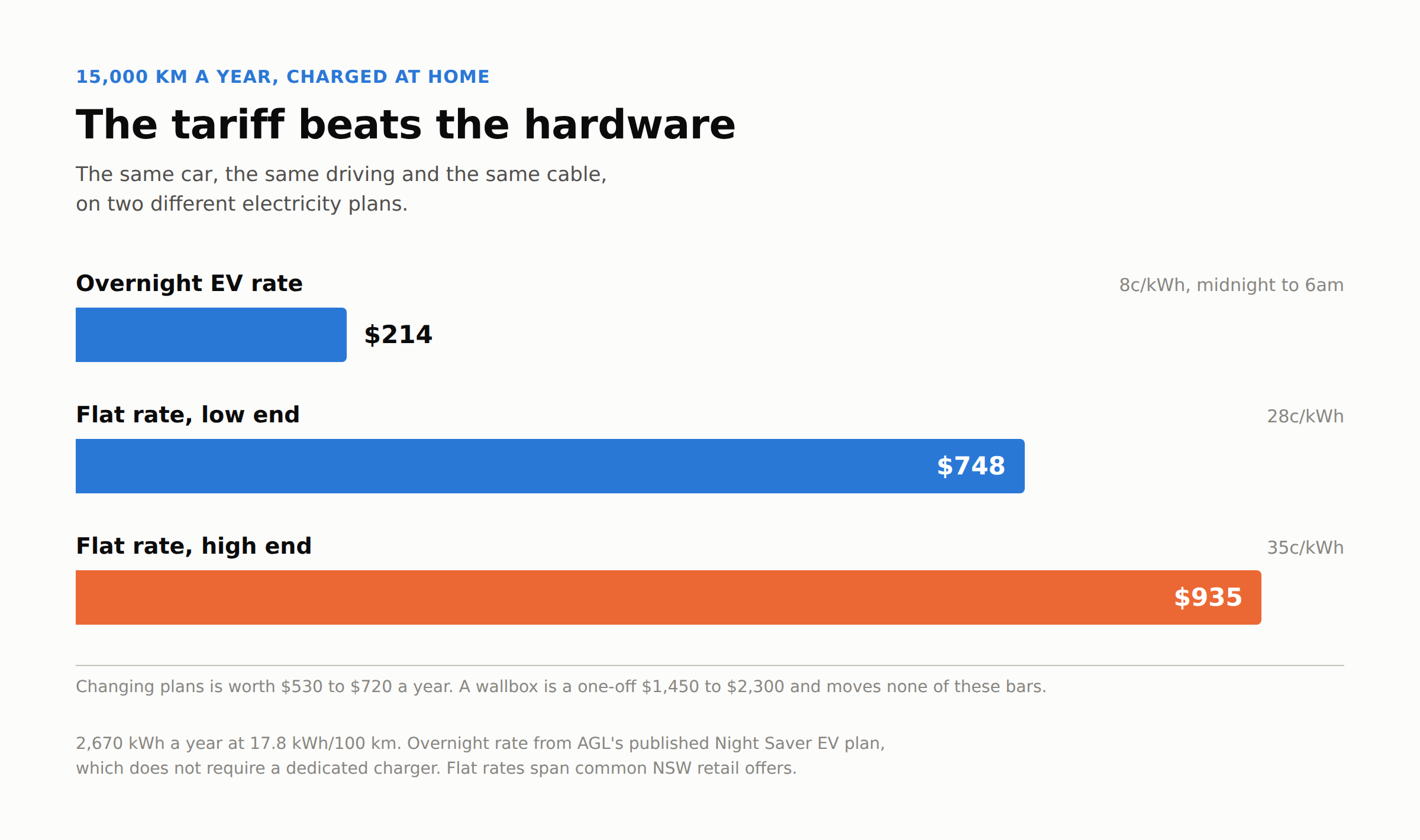
The tariff is where the money is. AGL’s Night Saver EV plan charges 8c/kWh between midnight and 6am, and states plainly on its own page that “you do not need a dedicated EV home charger to sign up for or use the Night Saver EV Plan.”
On 2,670 kWh a year, 8c costs about $214. The same driving on a flat rate somewhere between 28c and 35c costs $748 to $935. That $530 to $720 gap is several times what the hardware decision is worth, and you get it by changing plans, not by changing hardware.
Three conditions before you bank that. You need a digital meter, which is free but takes a couple of weeks. You need an EV registered at the address. And the plan moves your whole house onto a single general usage rate outside the window, so compare it against what you’re paying now rather than assuming the EV window is free money.
One point in the wallbox’s favour, since I’ve spent most of this section against it. Trickle charging from a power point is less efficient than charging at 7 kW, so you buy slightly more electricity per kilometre on the cable than you would on a wallbox. At 8c that difference is small. On a flat rate it isn’t nothing.
A wallbox is not pointless. It earns its money on consecutive long days, on fast turnarounds after a road trip, on two EVs in one house, and on soaking up midday solar at real power. What isn’t true is that you need one to own an EV, and the people telling you that you do are mostly selling them.
Before you rely on the cable, spend $150
The one thing worth doing before any of this is having an electrician look at the actual power point you’d use. Four hours a night near a socket’s rated current is a real duty cycle, and Australian houses have some very old sockets in them.
No Australian regulator publishes a warning about this and I’m not going to invent one. But the Electric Vehicle Council’s own guidance is that an EV supply should have “a dedicated circuit … No other appliances or outlets should be wired from the circuit supplying the EVSE”, and the Australian Government’s charging guidance describes trickle charging as suitable for “vehicles travelling less than 100km per day”. A short visit to check the socket, the circuit and the RCD is a fraction of a wallbox and it’s the thing I’d spend money on first.
The solar question, which is oversold
Solar-matching chargers watch your meter and only feed the car surplus you’d otherwise export. The Zappi and the Ocular IQ Home Solar do this properly, with CT clamps on the mains. It’s the headline feature in most of the marketing.
Here’s the structure of the decision, which is more durable than any single year’s numbers. Charging off surplus solar means giving up the feed-in tariff on that power. Charging overnight means paying the off-peak rate. So the value of solar-matching is just the gap between those two, and in NSW they sit within a few cents of each other: IPART’s all-day feed-in benchmarks have been in the single digits per kilowatt-hour, and the cheap EV window is 8c.
On 2,670 kWh a year, a few cents either way is a few tens of dollars a year. Against a hardware premium of roughly $500 for the surplus-matching version of the same brand, that’s a payback measured in many years, not a few.
The cheaper units already schedule charging, which gets you the overnight rate without the CT clamps. The case for true surplus matching improves if your retailer has no cheap overnight window, if you’re home during the day, or if you’d rather run the car off your own roof for reasons that aren’t financial. As an investment at current NSW feed-in tariffs, it’s marginal.
One thing NSW doesn’t ask for
South Australia requires new wall-mounted EV charging equipment to be capable of remote demand response, under a technical regulator guideline that started in July 2024. It doesn’t apply to detachable charging cables. NSW has no equivalent published requirement, and none of the three NSW distributors publishes a load-management condition on a home charger.
Fewer hoops here today, then. It also means a smart charger is a hedge rather than a compliance item, and I’d be cautious about paying much extra for a feature no Australian rule currently requires.
So what would I actually do
Work out your supply and your car’s AC limit first. Both are free to check and they set the ceiling.
Get the socket you’d use checked by an electrician, and get on a cheap overnight tariff. That’s where the $530 to $720 is.
Then run a month on the cable that came with the car. If it keeps up, and for average driving it should, you’ve saved yourself two thousand dollars. If it doesn’t, you’ll know exactly why you’re buying a wallbox, and you can put it on a zero-interest loan that also covers the switchboard.
I’ve worked through what the electricity itself costs across home, off-peak and public charging in the NSW running cost breakdown, which reaches the same place from the other direction: where you plug in matters far more than what you plug into.
Common questions
How much does a home EV charger cost in Australia?
Hardware runs from about $694 for a marked-down 7 kW unit to around $1,545 for one with surplus-solar matching, with Tesla’s Wall Connector at $800. Tesla puts a straightforward installation at $750 to $1,500, so a realistic all-in for single-phase 7 kW is roughly $1,450 to $2,300. A switchboard upgrade adds to that, and nobody publishes a credible figure for it.
Do I need a home EV charger, or is the supplied cable enough?
For 15,000 km a year, Tesla’s own figure of about 10 km of range per hour means roughly four hours a night, which fits inside a midnight-to-6am window with about 50 per cent to spare. A wallbox earns its place if you do consecutive long days, turn the car around quickly after trips, run two EVs, or want to charge fast off midday solar.
Is there a rebate for home EV chargers in NSW?
Not a rebate, but the NSW Home Energy Saver offers a zero-interest loan of up to $15,000 that lists both an EV Level 2 charger and a switchboard upgrade as eligible. NSW property owners, household income up to $210,000, and the charger must come from a New Energy Tech Approved Seller under the NETCC. The switchboard upgrade only qualifies alongside another eligible upgrade.
Do I need to tell my electricity distributor?
In Essential Energy’s area, yes: it states a Level 2 charger requires your electrician to lodge a new connection application, and it defines Level 2 as 8 kW to 22 kW. Endeavour Energy says chargers above 7 to 10 kW or needing a new circuit may require an application, and that a Level 2 install requires a licensed electrician to reassess your maximum demand. Ausgrid says you may be required to notify it. A plug-in Level 1 cable needs nothing.
Can I charge an EV from a normal power point in Australia?
Yes, and you don’t need to be a licensed electrician to use the cable that comes with the car. A 10 amp point delivers about 2.3 kW, which Tesla puts at approximately 10 km of range an hour on its own portable cable. The Australian Government describes this as suitable for vehicles travelling less than 100 km a day. Get the socket and its circuit checked before you rely on it nightly.
Is a solar-matching charger worth it?
Marginal at current NSW feed-in tariffs. The value is only the gap between the feed-in tariff you give up and the cheap overnight rate you’d otherwise pay, and in NSW those are within a few cents of each other. Against roughly $500 extra for the surplus-matching version of a charger, the payback runs to many years. Cheaper units already schedule charging into the off-peak window.
Leave a Reply