Nobody asking this question wants a number. They want to know whether they’re going to be handed a five-figure bill in year seven.
So: how long do EV batteries last? Longer than the warranty, and considerably longer than the car’s reputation suggests. I went looking for evidence instead of reassurance, and the useful findings weren’t the ones in the headlines.
On this page
- The number everyone quotes, and the better one underneath it
- What that does over the years you’d own the car
- The only Australian data anyone publishes
- How often do these things actually fail
- What actually wears a battery out
- What your warranty actually covers, and where the brands differ
- The bill nobody can actually quote you
- Your rights don’t stop when the warranty does
- So how long do they last
- Common questions
The number everyone quotes, and the better one underneath it
For about two years the standard citation has been Geotab’s fleet telematics study and its finding of 1.8 per cent capacity loss a year, across 11 common EV models. Geotab’s current analysis, updated April 2026, puts the average at 2.3 per cent, from over 22,700 vehicles across 21 models.
Plenty of coverage has read that as batteries getting worse. Geotab says the opposite in as many words: “This return to a 2.3% average doesn’t mean batteries are getting worse.” It’s a return because 2.3 per cent was Geotab’s own figure back in 2019, before the 1.8 per cent result.
They give three reasons for it, and none of them is deterioration. More of the newer models charge at high power. The fleet mix now includes vans and MPVs, which average 2.7 per cent a year against 2.0 for light cars. And a larger share of the sample is very new, still inside the sharper drop most EVs show in the first year or two before the rate levels off.
Which brings up the number almost nobody reports, and the one I’d actually pay attention to:
“eight out of 11 of the same established models from our 2023 data set have stabilized to an impressive 1.4% average degradation per year”
That’s the like-for-like comparison. The same cars that produced 1.8 per cent three years ago are now settling at 1.4. The headline average went up because the fleet changed. The established cars got better.
Carry the caveats. Geotab has never published which years its data covers. These are fleet vehicles, which work harder than private cars. It isn’t peer reviewed, and Geotab sells fleet telematics. It’s still the largest real-world dataset anyone has.
What that does over the years you’d own the car
Geotab publishes eight-year projections, and it’s worth noticing how they’re calculated. The average battery is “projected to have 81.6% of its original capacity (state of health or SOH) after eight years”. That is 2.3 multiplied by eight, subtracted from 100. Their model is straight-line.
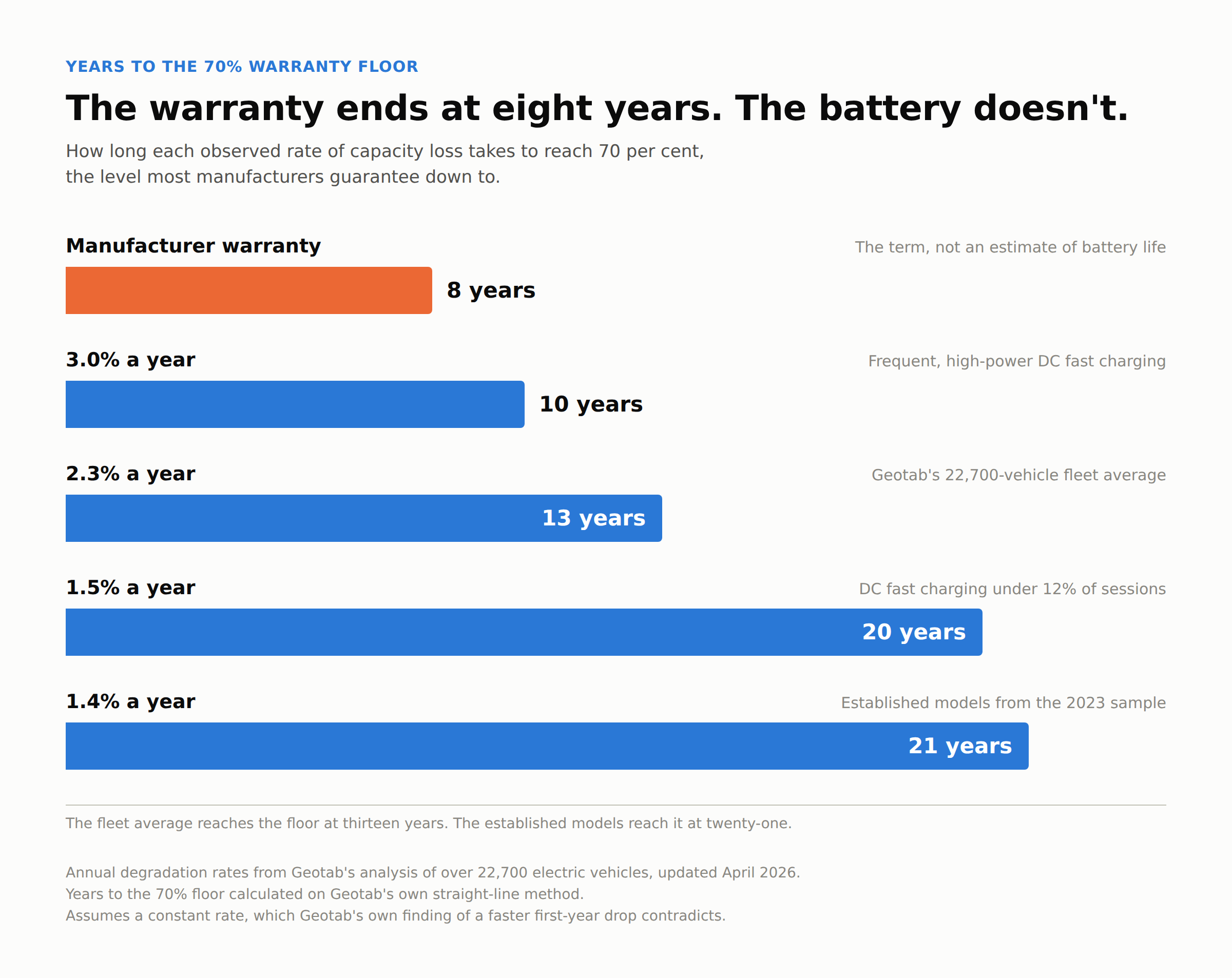
So here’s when, on their arithmetic and not one of my own, each rate reaches the 70 per cent floor most manufacturers guarantee down to:
| Annual loss | Whose figure this is | Reaches 70% at |
|---|---|---|
| 1.4% | Established models from the 2023 sample | 21 years |
| 1.5% | Vehicles where DC fast charging is under 12% of sessions | 20 years |
| 2.3% | The 22,700-vehicle fleet average | 13 years |
| 3.0% | Frequent, high-power DC fast charging | 10 years |
Those year figures are mine, extrapolated from Geotab’s rates on Geotab’s own straight-line method. They also assume a constant rate, which Geotab’s own finding about the early drop-off contradicts. If loss really is front-loaded and then flattens, the real figures are longer than these.
The warranty runs out at eight years. On the fleet average the battery reaches the warranty floor at about thirteen, and on the established models at twenty-one. The eight-year term is a commercial decision, not an engineering estimate, and treating it as the battery’s life expectancy is the mistake underneath most of the worry about this.
The only Australian data anyone publishes
I looked for Australian degradation figures and there is almost nothing. The CSIRO publishes on battery safety and EV uptake, not in-service capacity loss. The Electric Vehicle Council has no study. No Australian university publishes one. The AAA’s real-world testing programme gets cited here, and it measures new cars’ range against their claimed figures, not capacity loss over time.
The exception is Pickles, the auction house, which now issues battery certificates. As at October 2025: “With over 1000 vehicles tested to date, the average battery SoH score across Pickles’ EV fleet is an impressive 96 per cent”, on vehicles “approximately 2.5 years old with 30,000km travelled”.
Geotab’s fleet average over 2.5 years would put you at about 94 per cent, so the Australian number looks slightly better. I wouldn’t lean on that comparison. Pickles determines its scores from a mix of manufacturer BMS data and independent diagnostics, not one consistent physical test, Geotab measures capacity from telematics, and the two aren’t on the same basis. Auction stock also skews ex-fleet and ex-lease, and two and a half years is young. Take it as reassuring rather than as a ranking.
How often do these things actually fail
Rarely, and the trend is steep.
The US Department of Energy published in April 2024, drawing on Recurrent’s data from about 15,000 vehicles, that battery replacements due to failure ran at 1.5 per cent across model years 2011 to 2023, and “well under 1%” for recent model years. Recurrent’s own November 2025 update, across more than 30,000 cars, puts cars from 2022 onwards at 0.3 per cent.
Two things to hold alongside that. The DOE figure explicitly excludes recall replacements, which takes out the Chevrolet Bolt and Hyundai Kona battery programmes and most of the battery swaps that have actually happened. And Recurrent detects replacements partly by watching for unusual jumps in a car’s range, which is inference, not service records.
Read carefully, the finding is that spontaneous battery failure is rare and getting rarer, and that the batteries which did get replaced were mostly recalled, not worn out.
What actually wears a battery out
The advice on this is more confident than the evidence supports, so here it is graded.
DC fast charging. It matters, and how much depends on who you ask. Geotab’s split is clean: vehicles where DC fast charging is under 12 per cent of sessions average 1.5 per cent a year, and vehicles above that threshold average 2.5 per cent. Split the heavy users again by power and the ones frequently pulling above 100 kW sit at 3.0 per cent, while frequent low-power users sit at 2.2.
Against that, Recurrent analysed about 13,000 Teslas and found “no statistically significant difference in range degradation between fast charging more than 70% of the time and fast charging less than 30% of the time”.
The two aren’t measuring the same thing. Geotab tracks capacity, Recurrent tracked range, and they split their samples on different variables. Recurrent’s own caveat is that its data covers five or six years and “we do not know if there is a cumulative effect that will be seen in these batteries’ futures”. If you rely on public rapid charging, plan on it costing you something, and don’t let anyone tell you the size of it is settled.
Charging to 100 per cent. Weak and contradictory. Geotab says outright that “for most EV use, there’s no need to worry about avoiding fully charging or emptying the battery”. Laboratory work at Dalhousie University found cells held between 75 and 100 per cent state of charge lost far more capacity than cells cycled low, but that was a small number of laboratory pouch cells run at 40 and 55 degrees, temperatures a car’s pack doesn’t see. The fleet data doesn’t show the penalty the accelerated cells do.
LFP versus NMC chemistry. No real-world comparison exists. Geotab makes no LFP-versus-NMC split. Tesla’s own long-distance durability figures don’t cover its LFP cars. The claim that LFP lasts longer rests on cycle-life specifications, not on comparing actual vehicles.
Calendar age versus kilometres. No clean study separates them. What both Geotab and Recurrent observe is a non-linear curve: a faster drop early, then a long plateau. Anyone quoting you a split between the two is modelling, not measuring.
What your warranty actually covers, and where the brands differ
Most EVs sold in Australia carry eight years of high-voltage battery cover. The differences are in the kilometre cap and in whether the manufacturer commits to a capacity figure at all.
| Brand | Battery warranty | Capacity floor stated |
|---|---|---|
| Geely | 8yr / unlimited km | 70% |
| GWM | 8yr / unlimited km | 70% |
| Deepal | 8yr / 240,000 km | none |
| Tesla | 8yr / 160,000 km base, 192,000 km on Long Range and Performance | 70% |
| Mercedes-Benz | 8yr / 160,000 km, 10yr / 250,000 km on EQE and EQS | none |
| BYD, Hyundai, Polestar, Volvo, Nissan, Zeekr, XPeng, Subaru, Leapmotor, BMW | 8yr / 160,000 km | varies, see below |
| Kia | 8yr / 160,000 km on MY2027 onwards and on the EV4 of any year, 7yr / 150,000 km otherwise | 70% |
| Cupra | 8yr / 160,000 km, on a graduated scale | 78% at 3yr, 74% at 5yr, 70% at 8yr |
| Toyota | 8yr / 160,000 km, extendable to 10yr with annual health checks | 70% |
| MG | 7yr / 150,000 km | none |
| Mini Electric | 8yr / 100,000 km | none |
Terms taken from each manufacturer’s own Australian warranty documentation, read in August 2026. Commercial and rideshare use reduces cover on most of these. I’ve left Ford out because I couldn’t get its Australian high-voltage battery terms from Ford’s own documents instead of a marketing page.
Three things fall out of that table.
The kilometre cap almost never binds for a private buyer. A 160,000 km cap over eight years is a limit for anyone doing more than 20,000 km a year. The Australian average is around 12,000, which reaches 96,000 km by year eight, well inside it. For most people the years run out first and the cap is irrelevant. Above 20,000 km a year it flips, and Geely and GWM’s unlimited-kilometre terms start being worth real money.
Not every brand promises a capacity number. Where a percentage appears it’s almost always 70 per cent of original capacity. But BMW, Mini, Mercedes-Benz, MG, Zeekr, XPeng, Leapmotor, Subaru and Deepal state no percentage in their Australian documentation. BMW and Mini use the phrase “excessive capacity loss”, which is a judgement, not a threshold. Nissan doesn’t use a percentage either, guaranteeing nine bars on the dashboard gauge instead. Cupra is unusual in publishing a graduated scale instead of one endpoint.
Most manufacturers don’t publish how a claim gets measured, though some specify enough to argue from. BMW and Mini tie it to a capacity check at their own workshop. GWM states the criterion as a State of Health reading at or above 70 per cent. Toyota goes furthest and requires an annual dealer battery health check, and missing those checks costs you the cover.
Terms also move, and not always the way you’d assume. Kia’s battery cover improved with model year 2027, so comparisons written last year quote a shorter term than a current car actually has. If a warranty is part of why you’re choosing a car, get it confirmed against the specific build and model year in front of you, not a review. Any dealer can do that in a minute; on the north shore Zeekr Chatswood will have it for a given 7X build.
The bill nobody can actually quote you
Here’s the honest position: no Australian dealer, insurer or manufacturer publishes battery replacement pricing. I could not find one current quotable figure.
What circulates in Australian media traces back to three things. The NRMA’s often-cited $14,000 for a Tesla Model 3 pack comes from a single owner invoice from 2022, excluding installation. The rest of the NRMA’s table is headed as projected costs and calculated from global battery cost forecasts, not quotes, though it gets repeated as though it were pricing. And the larger numbers, the $20,000-plus figures, are currency conversions of United States data.
There’s a second reason those numbers mislead. Module-level repair exists in Australia, and replacing failed cells costs a fraction of a new pack. No Australian repairer publishes EV pricing either, so I can’t give you a figure, but a full pack replacement is the worst case, not the expected one.
If you see a confident battery replacement price for an Australian car, ask where it came from.
Your rights don’t stop when the warranty does
Worth knowing, because it changes the risk. The ACCC’s position is that consumer guarantees under Australian Consumer Law run independently of any manufacturer warranty and “don’t have a specific expiry date”, and that the guarantee period “might be longer than the period of any warranty provided by a retailer or manufacturer”.
There’s no ACCC benchmark for how long an EV battery should last, so nobody can tell you what a court would consider reasonable. But a battery failing at nine years on a $60,000 car is not obviously outside it. Start with the retailer who sold you the car, since that’s where the guarantee sits most directly, though the law also allows action against the manufacturer or importer.
So how long do they last
Longer than the warranty, and much longer than the reputation.
The fleet average loses about 2.3 per cent a year, which reaches the 70 per cent warranty floor at around thirteen years on Geotab’s own arithmetic. The established models in that same dataset have settled at 1.4 per cent, which gets you past twenty. Spontaneous failure runs at well under one per cent on anything recent. Australian auction stock is testing at 96 per cent after two and a half years.
What I’d actually plan for is the opposite of what people worry about. The battery is unlikely to be what ends the car. What’s genuinely unknown is what these cars are worth secondhand, which I’ve written about in the five-year cost comparison, and that’s the number with real money in it.
Common questions
How long do EV batteries last in Australia?
On Geotab’s fleet data, capacity falls about 2.3 per cent a year, which on their own straight-line method reaches the 70 per cent level most warranties guarantee down to at around thirteen years. The established models in that dataset have settled at 1.4 per cent a year, which pushes it past twenty. Australian auction data from Pickles shows an average 96 per cent state of health on cars about two and a half years old. Manufacturer warranties run to eight years, which is a commercial term, not an estimate of the battery’s life.
Do EV batteries need replacing?
Rarely. US Department of Energy figures put replacement due to failure at 1.5 per cent across 2011 to 2023 models and well under 1 per cent for recent ones, and Recurrent puts cars built from 2022 at 0.3 per cent. The DOE figure excludes recall replacements, which is where most real-world battery swaps have come from.
How much does it cost to replace an EV battery in Australia?
No Australian dealer, insurer or manufacturer publishes a price. The figures in circulation are a single 2022 owner invoice, currency conversions of American data, or projections from global cost forecasts. Module-level repair of failed cells is available here and costs far less than a full pack, but no Australian repairer publishes EV pricing either.
Does DC fast charging ruin your battery?
It costs you something, and how much is unsettled. Geotab found vehicles where DC fast charging is under 12 per cent of sessions average 1.5 per cent annual loss, against 2.5 per cent above that threshold and 3.0 per cent for frequent high-power charging. Recurrent analysed about 13,000 Teslas and found no statistically significant difference. The two studies measure different things, capacity against range, and split their samples differently, so they aren’t directly comparable.
What voids an EV battery warranty in Australia?
Commercial or rideshare use reduces cover on most brands. Beyond that the conditions are brand-specific, not universal: BYD sets storage state-of-charge rules, Nissan excludes damage from daily charging to 98 to 100 per cent and from extreme temperatures, and Toyota requires annual battery health checks to keep its capacity cover. Notably, no brand’s Australian documentation sets a limit on how often you use DC fast charging.
Leave a Reply